
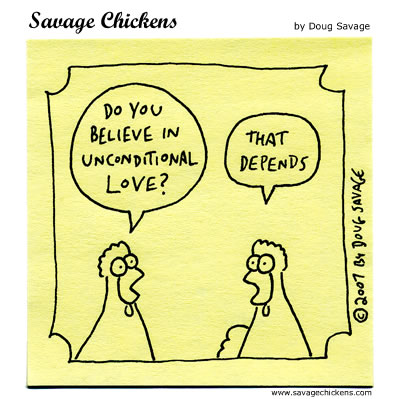
Americans today often confuse unconditional affirmation with unconditional love. Unconditional affirmation is what your dog gives you. He simply affirms you without challenging your innate desire to be the center of your own universe. That's why it feels so good.
Unconditional love, however, is not the same as unconditional affirmation. Love creates a crisis. And the greater the love, the greater the crisis. For love reaches out for union. For implicit within the gift of love is a calling of the other into relationship. To accept the gift of love is admit into our heart a power from outside ourselves that tugs at our very self-centredness, seeking to draw us into relationship by stirring up in us a desire to love in return the one who gave us the gift of love. Yet, the price of this relationship is a dent in our self-sufficient autonomy, where our selfish ways have thrived unquestioned. And the greater the love, the greater the loss of the right to live for oneself alone. And perfect, unconditional love seeks to stir up an equally unreserved giving of all of ourselves to the other. In short, true unconditional love does not simply affirm us in our self-satisfied self-centredness. True unconditional love provokes the ultimate crisis where we are called to die completely to our desire for autonomy and wholly give ourselves to the one who has already done the same for us.
The true meaning of the Gospel of Grace is this: that God unconditionally calls each of us to seek release from our selfish ways so that we can join the self-giving fellowship of the Father, Son and Holy Ghost, and his love is so at work in us to transform us that one day we will enjoy fellowship with God and one another as much as God enjoys fellowship within Himself.
Unconditional love, as most of us understand it, begins and ends with sympathy and empathy, with blanket acceptance. It accepts you as you are with no expectations. You in turn can take it or leave it.
But think about what God’s love for you is like. God does not calmly gaze on you in benign affirmation. God cares too much to be unconditional in his love.
It is worth reading more of the context of these incredibly insightful quotations. Ashley Null's quotation is from this interview. The Powlison quotation comes from Seeing with New Eyes. Although he has written something very similar (maybe the same) in a little booklet entitled God’s Love: Better Than Unconditional. There are two quite different but complementary summaries here and here. All of those links will give you lots of food for thought.
Here is a bit more Powlison though, from his classic article "Idols of the Heart and 'Vanity Fair'" (HT DB):
The Gospel is better than unconditional love. The Gospel says, “God accepts you just as Christ is. God has ‘contraconditional’ love for you.” Christ bears the curse you deserve. Christ is fully pleasing to the Father and gives you His own perfect goodness. Christ reigns in power, making you the Father’s child and coming close to you to begin to change what is unacceptable to God about you. God never accepts me “as I am.” He accepts me “as I am in Jesus Christ.” The center of gravity is different. The true Gospel does not allow God’s love to be sucked into the vortex of the soul’s lust for acceptability and worth in and of itself. Rather, it radically decenters people—what the Bible calls “fear of the Lord” and “faith”—to look outside themselves.
Incredible stuff! Mind-blowing truths! May we never stop praising and proclaiming God's unconditional love. But in conclusion, I think David Powlison is spot on here:
We do not need to use a vague, abstract word like unconditional when the Bible gives us more vivid and specific words, metaphors, and stories to communicate what God’s love is like.
