
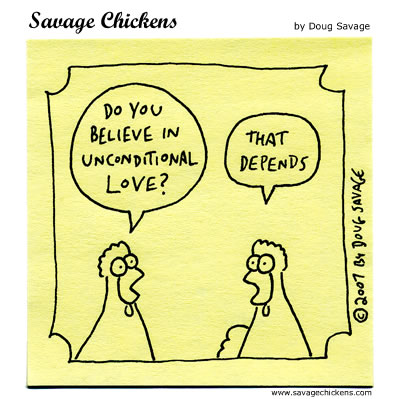
Americans today often confuse unconditional affirmation with unconditional love. Unconditional affirmation is what your dog gives you. He simply affirms you without challenging your innate desire to be the center of your own universe. That's why it feels so good.
Unconditional love, however, is not the same as unconditional affirmation. Love creates a crisis. And the greater the love, the greater the crisis. For love reaches out for union. For implicit within the gift of love is a calling of the other into relationship. To accept the gift of love is admit into our heart a power from outside ourselves that tugs at our very self-centredness, seeking to draw us into relationship by stirring up in us a desire to love in return the one who gave us the gift of love. Yet, the price of this relationship is a dent in our self-sufficient autonomy, where our selfish ways have thrived unquestioned. And the greater the love, the greater the loss of the right to live for oneself alone. And perfect, unconditional love seeks to stir up an equally unreserved giving of all of ourselves to the other. In short, true unconditional love does not simply affirm us in our self-satisfied self-centredness. True unconditional love provokes the ultimate crisis where we are called to die completely to our desire for autonomy and wholly give ourselves to the one who has already done the same for us.
The true meaning of the Gospel of Grace is this: that God unconditionally calls each of us to seek release from our selfish ways so that we can join the self-giving fellowship of the Father, Son and Holy Ghost, and his love is so at work in us to transform us that one day we will enjoy fellowship with God and one another as much as God enjoys fellowship within Himself.
Unconditional love, as most of us understand it, begins and ends with sympathy and empathy, with blanket acceptance. It accepts you as you are with no expectations. You in turn can take it or leave it.
But think about what God’s love for you is like. God does not calmly gaze on you in benign affirmation. God cares too much to be unconditional in his love.
It is worth reading more of the context of these incredibly insightful quotations. Ashley Null's quotation is from this interview. The Powlison quotation comes from Seeing with New Eyes. Although he has written something very similar (maybe the same) in a little booklet entitled God’s Love: Better Than Unconditional. There are two quite different but complementary summaries here and here. All of those links will give you lots of food for thought.
Here is a bit more Powlison though, from his classic article "Idols of the Heart and 'Vanity Fair'" (HT DB):
The Gospel is better than unconditional love. The Gospel says, “God accepts you just as Christ is. God has ‘contraconditional’ love for you.” Christ bears the curse you deserve. Christ is fully pleasing to the Father and gives you His own perfect goodness. Christ reigns in power, making you the Father’s child and coming close to you to begin to change what is unacceptable to God about you. God never accepts me “as I am.” He accepts me “as I am in Jesus Christ.” The center of gravity is different. The true Gospel does not allow God’s love to be sucked into the vortex of the soul’s lust for acceptability and worth in and of itself. Rather, it radically decenters people—what the Bible calls “fear of the Lord” and “faith”—to look outside themselves.
Incredible stuff! Mind-blowing truths! May we never stop praising and proclaiming God's unconditional love. But in conclusion, I think David Powlison is spot on here:
We do not need to use a vague, abstract word like unconditional when the Bible gives us more vivid and specific words, metaphors, and stories to communicate what God’s love is like.

The idea of God loving me because he sees someone else in me is rather unappealing. In a human relationship it would be monstrous.
ReplyDeleteI agree but I don't think that is what the quotations are saying (quite).
ReplyDeleteImagine you get married. You're parents will love your wife because they love you. Cf. John 16: "In that day you will ask in my name, and I do not say to you that I will ask the Father on your behalf; for the Father himself loves you, because you have loved me and have believed that I came from God."
Imagine that you hope to have children. Do you love the children before they are even conceived? I think you do, and in fact your love for them creates them. In a similar way God loves his creation and so he created it. He loves sinners who have unlovely, but his love creates that loveliness in them.
So much more could be said but those are some initial thoughts.
What does
ReplyDeleteGod never accepts me “as I am.” He accepts me “as I am in Jesus Christ.”
mean then?
That is very different from parents' love for children.
I do agree, btw, that the idea of unconditional love is not terribly helpful and can make people rather babyish. But I don't see how accepting that God completely loves someone else (Christ) and for that reason loves me is much better.
That he accepts me "in Jesus Christ" does not mean that he doesn't accept me, but that he only accepts me through Jesus. It doesn't mean that Jesus replaces me, or absorbs me, but that he sprinkles me with his blood and so goes before me into God's presence as my priest.
ReplyDeleteIf I wanted to see the Queen, I would need someone to make my introduction. There is no way that the Queen would see me just "as I am", bu she may send out a mediator to invite me in and introduce me into her presence.
It is difficult because human analogies always fall down in part. As Powlison says the biblical metaphors and words are probably best, and te priestly ones are probably among the best.
In short though I would say that God loves us because he first loved Christ. It is not that he doesn't love us, but that he loves us because he loves Christ. That includes the concept of substitution, but that is not the only way to look at it (after all he loved us enough to send his son to be our substitute in the first place).
But Christ is the only mediator between God and man (1 Tim), and so God never loves me "just as I am" in terms of unconditional affirmation. Neither does he love me conditional on becoming something intrisically worthy. Christ will always be my mediator.
How would you descibe that God loves you?
I don't think about God loving me much.
ReplyDeleteI think God's love is his not wanting me to sin and a constant summons towards perfection.
I do find the priestly metaphors helpful too.
That's a stark statement Steve. Really sad to hear that. I admit it isn't in my mind as much as it warrants, but if God's love for us is not at the centre of our faith then that's pretty dark.
ReplyDeleteI think God's love does include what you say because God's law (which is what you describe) is a good gift to us. But, far, far greater is his love for us in sending his Son to die for those who loved the very opposite of wanted for us because of his love (sinless perfection):
"one will scarcely die for a righteous person—though perhaps for a good person one would dare even to die— but God shows his love for us in that while we were still sinners, Christ died for us... while we were enemies we were reconciled to God by the death of his Son" (Romans 5)
God's love must be at the heart of Christian faith.
ReplyDeleteBut God's love is universal: he loves all equally. It's not therefore like human love where we love particular people for particular reasons. So it seems no good to me to think of good loving *me* for anything to do with myself - or (to go back to the point of the original post) to derive comfort or self-acceptance from it in the way we do from a human lover.
God's love is for all (for the world). What does this mean? Precisely, I think, what I said in my previous post - and Christ's sacrifice is part of this will not an abrogation of it.
Hi Steve,
ReplyDeleteSorry for taking so long to reply. Things have been fairly busy and I couldn't think of a quick response, so I'll stick to some questions.
Can we comforted without self-acceptance?
I would agree that God doesn't love me for anything inherently lovely in me, but why does that mean it is irrelevant that he loves me? Surely it makes all the difference in the world that he loves me, not just 'the whole world', or 'the church', when I'm suffering now and God's judgment is coming?
On your comment, "God's love is his not wanting me to sin and a constant summons towards perfection", there is a old slogan that in Christ God gives what he commands (or in your case 'summons') which I think is worth muling over.
As I've struggled to think of something useful to say, and I think we should continue conversation on phone/in person, I keep on thinking of this hymn:
My song is love unknown,
My Savior’s love to me;
Love to the loveless shown,
That they might lovely be.
O who am I, that for my sake
My Lord should take, frail flesh and die?
... sorry that is a fairly rubbish comment. I just can't think where is the best place into this discussion which is obviously so wide.
Look forward to speaking. If I've understood your 2nd para correctly, you now seem to be arguing more against the original post and I more in line with it! Shurely not?!
ReplyDeleteReally like the blog redesign!
Now I'm properly confused. I don't know who is arguing what!
ReplyDeleteGlad you like the redesign. I can't take much credit though I'm afraid.
I like to take this chance to state that I really like your post. It has been a fine source of information for me in my study. Thank you so much.
ReplyDeleteUNCONDITIONAL LOVE