
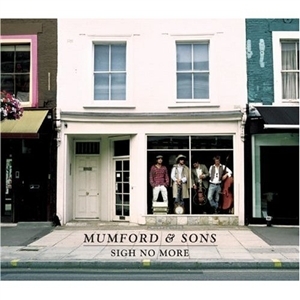
Sigh No More by Mumford and Sons is a great album. But, contrary to many Christian commentators I cannot see it as an album full of grace.
Marcus Mumford is the son of two of the leaders of the Vineyard group of churches in the UK [1]. But in interviews he and the other band members don't speak very much about their religious beliefs so, although it seems at least some of them are Christians [2], I don't know what he believes now. The album is full of biblical allusions and Christian jargon, but it is also an album of struggles with a God who accuses.
I think "Roll Away Your Stone" is a song in conversation with God, although you can also imagine it being between Mumford and his parents. It contains a description of grace in the third verse drawing upon imagery from the Parable of the Prodigal Son in Luke 15 (which has echos in other parts of the album).
It seems that all my bridges have been burnt
But you say that's exactly how this grace thing works
It's not the long walk home that will change your heart
But the welcome I receive with the restart
By itself that is powerful indication that he knows something of the power of grace to conquer all that he has done. And yet, the walk is a 'long' one and it is not clear whether he thinks he can make it to the welcome at the end.
The rest of the song is much darker. The first verse is an invitation to mutual confession and investigation into past. He'll "roll away" the stone to let the light into the cave/grave of his soul, but he's afraid of what he "will discover inside". In the second verse he recalls how he's been told that he would find within his soul a "void" or "hole" (perhaps the god-shaped hole people often talk about). But on self-examination he has filled that hole "with things unreal" that steal his character.
He recognises that this all seems quite dark, so in the chorus he protests that he should sing about it becuase "it dominates the things" he sees.
As the third verse of grace I quoted follows these bleak reflections on his sins, you may see a movement from guilt to forgiveness in the song. But the fourth and fifth verses suggest that he doesn't embrace this "grace", but recoils from it.
"Stars hide your fires" is a quotation from Macbeth Act 1, Scene 4:
Stars, hide your fires,
Let not light see my black and deep desires
And John 3:19-20 is also brought to mind:
Light has come into the world, but people loved darkness instead of light because their deeds were evil. Everyone who does evil hates the light, and will not come into the light for fear that their deeds will be exposed.
The light has shone into his life, he's seen his plight, but I'm not sure that he can embrace the salvation in verse 3. He will stick his stake in the ground "Marking the territory of this newly empassioned soul". He wants to declare his ownership of his own soul because, as he says to the person he is addressing, "you've gone too far too far this time" and have no justification "to take this soul that is so rightfully mine".
It seems that he comes so close but in the end cannot surrender his life to a God he doesn't quite trust or love. It's really a very sad song, and a very sad album.
In other songs he suggests that the accusation of sin is what has driven him from God. In "the Cave" he sings, "The shame that sent me off from the / God that I once loved". "Timshel" is a reflection on the Lord seeming to offer a choice to Cain of whether sin will rule over him or not according to John Steinbeck's East of Eden. "Little Lion Man" is dominated by guilt and the fear that "grace is wasted". "Thistle and weeds" has obvious illusions to the Parable of the Sower. In "Awake my Soul" he looks to the day when he will "meet [his] maker" - not a phrase used by those looking forward to Christ's return.
"Dust Bowl Dance" is perhaps the darkest song of all. To me he seems to see Jesus, God's "only son", as his "accuser" who will lay out the singer's crimes before announcing he'll get his gun to execute judgment. The singer then steals himself, admits his crimes but seems to declare he'll fight back by going to get his own gun!
Please correct me if you think I'm hearing the album wrongly, but the grace is surely a minor note in the Album. Perhaps I'm the one only seeing darkness, but guilt seems to be the dominant note.
Instead of being laid at the foot of the cross, Sigh No More is an album where recognition that we are sinners drives Marcus Mumford to stand his ground and take on his accuser head on. However, what seems clear is that doing that has not led to release from the guilt that haunts him. His experience does not seem to have been that of Charles Wesley when he let light into the dungeon of his heart:
Long my imprisoned spirit lay,
Fast bound in sin and nature’s night;
Thine eye diffused a quickening ray—
I woke, the dungeon flamed with light;
My chains fell off, my heart was free,
I rose, went forth, and followed Thee.
My chains fell off, my heart was free,
I rose, went forth, and followed Thee.

No comments:
Post a Comment