Showing posts with label The Trinity. Show all posts

Thursday, January 07, 2016

God the giver

These are the three persons and one God, who has given himself to us all wholly and completely, with all that he is and has. The Father gives himself to us, with heaven and earth and all the creatures, in order that they may serve us and benefit us. But this gift has become obscured and useless through Adam’’s fall. Therefore the Son himself subsequently gave himself and bestowed all his works, sufferings, wisdom, and righteousness, and reconciled us to the Father, in order that restored to life and righteousness, we might also know and have the Father and his gifts. But because this grace would benefit no one if it remained so profoundly hidden and could not come to us, the Holy Spirit comes and gives himself to us also, wholly and completely. He teaches us to understand this deed of Christ which has been manifested to us, helps us receive and preserve it, use it to our advantage and impart it to others, increase and extend it. He does this both inwardly and outwardly——inwardly by means of faith and other spiritual gifts, outwardly through the gospel, Baptism, and the sacrament of the altar, through which as through three means or methods he comes to us and inculcates the sufferings of Christ for the benefit of our salvation.(Confession Concerning Christ’ s Supper of 1528, LW 37:366)

HT Glen Scrivener/Gene Vieth

Tuesday, June 25, 2013

The Jesus-centred, Trinitarian gospel of Mark 1:1

"The beginning of the gospel of Jesus Christ, the Son of God"

Mark 1:1 beautifully frames the gospel as both Jesus-centred and Trinitarian. The gospel is about Jesus, but Jesus can only be understood in relationship to the Spirit who he is anointed ('Christed') with, and the Father he is "Son of".

We miss the Trinitarian nature of Mark 1:1, and so many other passages because when we read "God", we don't identify God with a person of the Trinity (usually the Father); and when we read "Christ", we read it as a surname, if we're lucky as a title, if we're really lucky as about being anointed, and very rarely as about who Jesus is anointed with.

"God [the Father] anointed Jesus of Nazareth with the Holy Spirit" (Acts 10:38)

Sunday, February 26, 2012

The Trinity in the wild weather

When Jesus Christ went to the cross, he was simply acting in character. As C. S. Lewis, wrote, when Jesus sacrificed himself for us, he did "in the wild weather of his outlying provinces" that which from all eternity "he had done at home in glory and gladness."

(p. 59, Tim Keller quoting CS Lewis who was quoting George MacDonald, The Meaning of Marriage)

Nothing but the Father's greatest desires

When our prayers are ascend to the Father through the intercession of the Son, the intercession of the Son represents nothing but the Father’s greatest desires in the first place, so guarantees the beautiful success of the Son’s prayers.

(Carl Trueman, 26:00, The Trinity and Preaching: Talk 1)

Friday, October 21, 2011

The Forgotten Father

we have had in recent years a Jesus movement and a charismatic movement. The one has almost disappeared and the other is threatening to run out of steam, perhaps because each is in a different way inadequate to the gospel, which is basically a Father movement... It starts not with the cross of Jesus or with the gift of the Spirit, but with the Father who so loved the world that he gave his Son in his Spirit. And it achieves its purpose, not when the body of Christ is gloriously renewed in very part without spot or wrinkle (Ephesians 5:27), not even when the enthroned Christ has subdued all his enemies and brought every knee to bow before him (Philipians 2:11), but rather when that same Christ "hands over the kingdom to the Father, after he has destroyed all dominion, authority and power" (1 Corinthians 15:24). "When he has done this, then the Son himself will be subject to him who put everything under him, so that God may be all in all" (1 Corinthians 15:28).

(p.20, Thomas A. Smail, 1980, The Forgotten Father)

I like Tom Smail. He ought to be more widely read. His Charismatic Anglican Trinitarian Theology has a lightness of touch, while retaining real depth, which is really refreshing.

Considering those verses from 1 and 2 Corinthians it is striking that the Father is involved not just at the beginning and end but in the middle where he is the one who puts everything under Jesus' feet.

Tuesday, October 18, 2011

Expressions

Glory is the expression of someone by their love.

A word is the expression someone by their breath (Heb: ruach).

The Son is the expression of God the Father by his Spirit.

Why the doctrine of the Trinity is hard

Glen says that the doctrine of the Trinity is simple: it's just three persons united in love.

Glen argues that the reason we tie ourselves in knots is because we try to reconcile the 'omnibeing' with the Trinity: an impossible task because the two are not the same.

I'm thankful to Glen and others for giving me a crash course in the doctrine of the Trinity a few years ago and for continuing to teach me. Before, the doctrine was largely a maths problem I couldn't solve, but now I understand it far better than I did. Nevertheless, I still don't think I really understand the Trinity.

In part the problem is metaphysical, but more substantial is the failure of my imagination and experience. Three persons united in love don't exist in the world in which we live. Perfect, self-giving love is something I can barely grasp. I know and have experienced amazing love in relationships, family and church, but the more I know love the more I see how deeply broken it often is. I suspect those of you who are married can list off as many ways in which you are disunited as united, just as I can with my family and friendships. And the church is no exception in its present fractured-yet-united state. So until the sinless new creation I don't think I will ever be able to say that three persons united in love is simple.

In summary, the 'problem' of the Trinity lies not in logic but sin. If you do have a problem with the logic, then its probably not the Trinity you have a problem with.

Saturday, July 23, 2011

Unity and plurality

Colin Gunton notes that:

"Much recent thought has turned into a contest between exponents of the essential unity of things and those advocating a fundamental, even chaotic, plurality." (. 13, The Christian Faith)

In contrast to this war between the camps that emphasise unity (particularly Modernists) and those that emphasise plurality (particularly Postmodernists), Christianity sees no conflict. Gunton argues that the Bible has a doctrine of creation that emphasises both the "free and sovereign action", but also a pattern of mediation which gives "space" to creation to be itself.

Interestingly he then ties unity particularly to the work of the Son, and plurality to the work of the Spirit, both of whom the Father uses to create both old and new creations:

"while reference to Christ shows how we may hold the world together in unity, the Spiirit is the principle of reality's variety and multiplicity" (p. 14, ibid)

This makes sense to me particularly as I think of Paul and his teaching on the church. He appeals to the unity we as a body in Christ (cf. Col 1:17 which sees union in Christ in creation), but often sees the Spirit gives a diversity of gifts. Christ's saving work is seen supremely in his one action of incarnation, crucifixion, resurrection and ascension; but the Spirit works in countless individuals in a variety of times and places and ways. Of course each indwell the other, to the glory of the Father in Jesus Christ, so that there is harmony in the Trinity's work.

Tuesday, May 31, 2011

The Lord, the giver of life

In the Bible the Holy Spirit is tied closely to lots of concepts, off the top of my head:

  • peace
  • power
  • wind/breath
  • love

But he is particularly strongly bound to the idea of life. As the Nicene Creed confesses, he is "the Lord, the giver of life"...

"the Lord God formed the man of dust from the ground and breathed into his nostrils the breath of life, and the man became a living creature." (Gen 2:7)

"Thus says the Lord God: Come from the four winds, O breath, and breathe on these slain, that they may live...I will put my Spirit within you, and you shall live" (Ezek 37:9-14)

"That which is born of the flesh is flesh, and that which is born of the Spirit is spirit" (John 3:6)

"It is the Spirit who gives life" (John 6:63)

"'Peace be with you. As the Father has sent me, even so I am sending you.' And when he had said this, he breathed on them and said to them, “Receive the Holy Spirit." (John 20:21-22)

"was declared to be the Son of God in power according to the Spirit of holiness by his resurrection from the dead" (Romans 1:4)

"the law of the Spirit of life has set you free...to set the mind on the Spirit is life and peace...the Spirit is life...If the Spirit of him who raised Jesus from the dead dwells in you, he who raised Christ Jesus from the dead will also give life to your mortal bodies through his Spirit who dwells in you." (Romans 8:2-11)

Incidentally, I think that if you read flesh/spirit contrasts with connotations more of death/life than corporal/noncorporal, or even a bad/good, then you are being much more Biblical.

Tuesday, May 03, 2011

God's love in a rubbish diagram

How can you describe God's loving activity in a diagram? It feels so stupid to even try. God wrote a whole Bible, and I try and sum it up in a diagram! I know it is so incomplete but hopefully it communicates something true.

click for bigger image

This is what I'm trying to express:

  • God's love breaks down into two categories: God's love for the lovely, and God's love for the unlovely. Too often we oppose love to wrath. Or we equate love with mercy. Both are category errors of massive proportions with massive implications. Often I want to ask, "which love are you talking about?"
  • God's love for the lovely is initially our problem. But God's love for the unlovely means we are born again into Jesus Christ in whom God's love for the lovely become good news. There is a story. Initially God's love for the lovely (including, but not equal to wrath) is bad news, but it becomes good news if we are found in Christ as it means we are glorified and the enemies of the church are destroyed.
  • Everywhere you see an arrow see the Spirit. The Spirit is how God acts, and God's love is always active. The Spirit's principle action is love, so we can call him God's love (although he is also a personal lover).
  • I know that the it is a big omission that the diagram doesn't show how God's love for the unlovely is the reason that Jesus Christ is sent to be born in the flesh.
  • God's Son becomes flesh in order to experience the wrath that is a result of God's love for his Son. That is amazing love. Or, as the Bible calls it, 'grace'.
  • Yes, you've guessed it. God's love for the lovely corresponds to 'the [Lutheran doctrine of] law' - it is good, but death for sinful humanity. God's love for the unlovely corresponds to the 'Gospel' - wonderful undeserved grace!
  • God's love for the unlovely is totally incomprehensible. I dare you to make sense of it! It is pure grace, there is nothing in it for God, but he pours it out anyway!
  • One of the most amazing things that Martin Luther ever wrote was the final theological thesis of his 1518 Heildelberg Disputation. You could meditate on it for ages:
  • The love of God does not find, but creates, that which is pleasing to it. The love of man comes into being through that which is pleasing to it.

Thoughts welcome. Praise God for love!

Monday, May 02, 2011

Perichoretic salvation

In my previous post I quoted Fred Sanders who asked:

  • Did Good Friday and Easter happen so that Pentecost could benefit us, or
  • did Pentecost happen so that Good Friday and Easter could benefit us?

Another way of asking the question is:

  • Do we receive the Spirit in us because we are in Christ, or
  • are we in Christ because the Spirit is in us?

Yet another way of asking the question would be:

  • Is salvation the Trinitarian life of God in the soul of man (ala Scougal), or
  • is salvation the soul of man in the Trinitarian life of God?

If we believe that perichoresis (mutual indwelling) of the three persons of the Trinity is not a static state of being, but is a dynamic and continuous activity, then it is never 'or' it is always 'both' - distinct but one.

PS did you like my pompous title?!

The missions of the Son and the Spirit - each of them is a means to the other

Which of the two missions [of the Son and the Holy Spirit] is the means and which is the end? Thinking in terms of redemption accomplished and applied, it is easy to consider the Spirit's work as the means of delivering the Son's work. In that case the Son does the the thing itself - reconciling God and man - and the Spirit serves his work by applying it to individual lives. Pentecost, in this view, happens in order to fulfill and extend Calvary and Easter. On the other hand, when we consider the intimacy of spiritual fellowship that the indwelling of the Holy Spirit involves, it begins to look as if all God's ways lead up to the sending of the Spirit.

If God's goal is to dwell among his people, the atonement was a necessary step to make indwelling possible. The temple of human nature had to be cleansed to make it ready for the Spirit's indwelling. So the Son by incarnation prepared one perfect human temple, his own body, for the Spirit to be present in. And by atonement the Son purified the other temples, preparing them to receive the Spirit on the basis of the Son's finished work. "Christ redeemed us from the curse of the law by becoming a curse for us ... so that we might receive the promised Spirit through faith" (Gal 3:13-14), Calvary and Easter, in this view, happen in order to make Pentecost possible. If we have to ask whose work is the means and whose is the end, our answer must be either that the question is badly formed, or that each of them is a means to the other. The Spirit serves the Son by applying what he accomplished, and the Son serves the Spirit by making his indwelling possible. Both the Son and the Spirit, together on their twofold mission from the Father, serve the Father and minister to us.

(pp.148-149, Fred Sanders, Embracing the Trinity: Life with God in the Gospel)

Wednesday, April 20, 2011

Starting points for seeing the Trinity in the Bible

Robert Jenson points out the need to read the Bible as narrative to see the persons of the Trinity as dramatis personae in the Old Testament:

The church has its own way of reading Scripture. There are others. By way of putting the contrast let me say a word or two about the other most important way - Rabbinic Judaism...

Rabbinic Judaism reads the Old Testament fundamentally as Torah - guidance for life. The narrative simply provides the context. Now, this is obviously a perfectly possible way of reading the Old Testament, but it is not the Church's.... The Church's second volume, the New Testament, is fundamentally narrative, with comment on the narrative. The Church then reads the Old Testament from this viewpoint. From the viewpoint of this new volume and accordingly reads the Old Testament basically as narrative, with Torah and Wisdom and Prophecy providing the moral and spiritual context...

The narrative is of God's history with his people from creation to fulfilment...it is an obvious question, but one too often not asked, 'how would a narrative display the reality of God?'

How for example would a narrative show that God is merciful? Not primarily by pronouncing the proposition 'God is merciful', though it can do that too. Rather, by telling and pondering his merciful behaviour. Or by recording prayers uttered by his people on the way, prayers for mercy that are answered. Or by telling stories of heroes of Israel who found mercy with God...

So how would a narrative tell us that God is one God and three persons? It would not do it primarily, or perhaps even at all, by saying 'God is three persons' a proposition that indeed never appears in Scripture, but rather by telling a history of God with us which displays three actors, or as David Scaer put it 'three performers', of that history. Each of which is indeed other than the other two, and yet is at the same time the same God as the other two.

(10:00-14:50, MP3 lecture, Confessions - The Bible and the Trinity)

Richard Bauckham stresses that we should consider the concept of "divine identity" when reading the New Testament to find out the true identity, and not the nature, of Jesus Christ:

The God of Israel had a unique identity...the biblical God has a name and a character, since this God acts, speaks, relates, can be addressed and, in some sense, known...

personal identity [is] a concern with who God is. The value of the concept of divine identity appears partly if we contrast it with a concept of divine essence or nature. Identity concerns who God is; nature concerns what God is or what divinity is...That God is eternal, for example - a claim essential to all Jewish thinking about God - is not so much a statement about what divine nature is, more an element in the unique divine identity, along with claims that God alone created all things and rules all things, that God is gracious and merciful and just, that God brought Israel out of Egypt and made Israel his own people and gave Israel his law at Sinai and so on. If we wish to know in what Second Temple Judaism considered the uniqueness of the one God to consist, what distinguished God as unique from all other reality, including beings worshipped as gods by Gentiles, we must not look for a definition of divine nature but for ways of characterizing the unique divine identity...

Once the category of divine identity replaces those of function and nature as the primary and comprehensive category for understanding both Jewish monotheism and early Christology, we can see that the New Testament's lack of concern with the divine nature of Christ is by no means an indication of a merely functional Christology. We can see that, throughout the New Testament texts, there is a clear and deliberate use of the characteristics of the unique divine identity to include Jesus in that identity. Once we have rid ourselves of the prejudice that high Christology must speak of Christ's divine nature, we can see the obvious fact that the Christology of divine identity common to the whole New Testament is the highest Christology of all. It identifies Jesus as intrinsic to who God is.

(pp.6-31, Richard Bauckham, "God Crucified" in Jesus and the God of Israel)

Thursday, January 20, 2011

Rich in giving

Romans 11:36:

For from him and through him and to him are all things. To him be glory forever. Amen.

These simple words of praise give an all-encompassing view of the world and its purpose. All things come from God, are sustained through him, and will eventually flow back to him as the ultimate Owner of everything...

God did not create to satisfy any inadequacy or need of his own, but out of the fullness of his delight and love, this delight and love flow to the creatures as generosity and back to God as thanksgiving and praise...Our good has by his hand become a means of God's ultimate glory, intrinsically connected (cf. Ezek. 36:22-27)...

As God's giving does not impoverish but enriches him, so we as we offer back to God the fits he has given and sanctified in us, are enriched in his glory and satisfied in and through him.

(pp.24-25, Kelly M. Kapic, With Justin L. Borger, God So Loved, He Gave: Entering the Movement of Divine Generosity)

Saturday, January 15, 2011

The terrifying and comforting Triune God who is love!

1. Why the loving community of the Trinity is terrifying

The Father has loved the Son by the Spirit for all eternity. Before we were born the three persons of the Trinity were dancing and conversing together singing the praises of one another. They couldn't love each other more.

...and we killed the Father's only Son.

His wrath will be devastating (Mark 12:1-9).

2. Why the loving community of the Trinity is comforting

The Father has loved the Son by the Spirit for all eternity. Before we were born the three persons of the Trinity were dancing and conversing together singing the praises of one another. They couldn't love each other more.

...and the Father gave us his relationship with his only Son when he sent his Son to die and raised the New Adam from the dead; and the Son gave us his relationship with the Father by calling us brothers as he queued with sinners to be baptised by John and went to die between two robbers; and the Spirit has caught us up into this eternal loving community by breaking into our hearts and opening them to God.

We rejoice, and by his Spirit we intensely and eternally love the Father and Son.

What is the difference?

  1. is the Trinity expelling foreign objects and destroying them.
  2. is the Trinity including foreign objects in Christ and transforming them.
  1. is the Trinity acting understandably.
  2. is the Trinity acting incomprehensibly in Christ crucified.
  1. is the Trinity acting in the Son's divine nature.
  2. is the Trinity acting in the Son's hypostatic union.
  1. is the Trinity speaking to us.
  2. is the Trinity speaking to us by speaking to the Father in Christ.
  1. is God in his eternal being, our act apart from Christ, and his response.
  2. is God in his eternal being, his act in Christ on our behalf, and our response.
  1. is thinking about the Trinity from the outside - looking in through the windows.
  2. is thinking about the Trinity when we've been brought in from the cold.
  1. is law.
  2. is Gospel.
  1. is death to us.
  2. is life to us.

The difference is not whether we are talking about the Triune God who is love or some other God.

The loving community of the Trinity is never good news apart from Christ going to the cross for us.

Sunday, January 02, 2011

Where is our authority?

Listening to: Mozart: Die Zauberflöte (Klemperer)

The Father's authority: God the Father is the supreme authority, Creator of heaven and earth.

The Son's gifted authority: He has given all authority to his Son (John 17:2). The Father is in him so he carries the Father's authority, but (importantly) he is also in the Father (John 10:38) so while that authority is delegated it is of the very being of the Father that he acts to give authority to the Son whom he loves. It couldn't be any other way.

The Church's gifted authority: By his Spirit the Son abides in his church and we abide in him (John 15:4). It is a mutual indwelling that mirrors the mutual indwelling that the Father and the Son have together (John 17:11). The Son is gifted authority by the Father, the church is gifted authority by the Son. However, Christ is the head of the body because we do not dwell in the Father, and we are one step removed from the Father who is the source of all authority.

The gifted authority of reason and the civil authorities: The authority of the reason and the civil authorities is also derived from the Son. In the New Creation it will merge with the authority of the church as the personel will totally overlap! Even now it cannot be utterly separated because there is some overlap (Christian judges, Christian bosses etc). What distinguishes the two in the present is the word they have been given to speak. The civil authorities are given the word of order (the word of creation - or better 'continuing creation') and church is given the word of the cross (the word of redemption - or 're-creation').

The power and reality of the gift in the word and Spirit: This connection between the Church and Christ is effected by the Spirit which invariably accompanies the words of Christ (John 3:34). The words of Christ, are found for us in the Bible, and secondarily in the Church's word.

The sacramental word of Christ (the Bible): The Son abides in the Bible so that every word is said by him and about him. He fills every corner of the Bible, but he is not the Bible. The Son is the Word of God the Father, but the Bible is the Word of God the Son. It is through the Son's words dwelling in us that he dwells in us (John 15:7).

The sacramental word of the church (the word and sacrament): The Church hears from the Father in the Son. They hear from the Son in the Bible. They also hear from the Son in the word and sacrament, which re-present Christ of the Bible to us in countless fresh ways as he re-engages an ever changing world and individuals in ever changing situations.

The non-sacramental word of the civil authorities: This word creates order in creation but does not bring the Spirit with it. It cannot create from nothing (as the word of the Gospel can) but can only order creation as it is already there.

The difference that the presence of sin makes: We do not find sin present in either the Father's word to us, or in the Son's word to us. However, the church is caught between the ages. It is both Adam and Christ to the world, although constantly in the process of clothing itself with it's new identity in Christ. It dwells in the midst of the world (in the Johannine sense of fallen humanity), but the world also dwells within it, until the new Creation when it will be purged. Therefore the word of the church is fallible. At times it speaks the truth which comes from Christ, and at other times lies which come from the devil. The words of the church need therefore to be tested to see which spirit inspired them (this is true whether the words are prophetic or preached, and also true of sacraments which can be falsely administered). In one sense the Bible is the word of the church, not directly the words of Christ, but because it is untainted by lies of the Devil it has a priority over the church which remains a mixture of truth and lies until the second coming. It is the priority of being a norm by which to judge the words of the church. A prioritising of the church over the Bible is not wholly incorrect because the Bible was written by the church, but reflects a over-realised eschatology.

[I'm less sure about this bit] The difference that the absence of sin will make: The word and sacraments of the church are words of redemption to the fallen, whether in the world without or in world that still dwells in each of our hearts. Therefore when the New Creation is consummated then the church will stop declaring love to a sinful world that finds it difficult to believe because it will be seen and experienced (1 Corinthians 13:9-10). Instead it will experience love (we will no longer be the bride, but the wife) and we will act it out towards the rest of creation. The church will need to continue to speak to the created world as it rules creation as the civil authority, but it will be the word of continual creation not re-creation.

[This is pretty closely argued, and a massively important subject. I'm laying out a whole swathe of my systematic theology here so if you think I'm in error you should say so. This is why I'm not a Catholic, but also why criticism of bibliolatry can be warranted, but doesn't require you to believe in a fallible Bible. I'm sorry that I gave up on the Bible references for lack of time, but think I could give them for most of the sentences if you ask. I'm sorry as well that I didn't have the patience to edit it.]

Monday, December 27, 2010

Is this right?

The Father serves the Son. The Son serves the Father.. The circle is the circle of servanthood." (my italics, p. 80, Darrell W. Johnson, Experiencing the Trinity)

I know some of my readers know their Trinitarian theology better than me, but I cannot think of a verse that would suggest that the Father serves the Son. Certainly, the Son glorifies the Father and the Father glorifies the Son (although even that is not simply circular I don't think). Also the Father gives (life) to the Son. But doesn't the Son obey the Father and not vice versa?

Thursday, September 30, 2010

The invisible Father we see

Moses endured "because he saw him who is invisible" (Hebrews 11:27). That is an incredible statement, but the seeming contradiction is just an echo of what it says in Exodus itself. We are told "the Lord used to speak to Moses face to face, as a man speaks to his friend" (33:11), despite God saying later in the same chapter that "you cannot see my face, for man shall not see me and live" (33:20)!

John confirms the witness of Old and New Testaments that "no one has ever seen God" (John 1:18), but helps clarify things later by naming the God "no one has ever seen" as the Father (6:46). Later in the John's Gospel Jesus explains that we can see his Father (gaining life), while still not seeing him (avoiding death) when he gives us that promise that "whoever has seen me has seen the Father" (14:9).

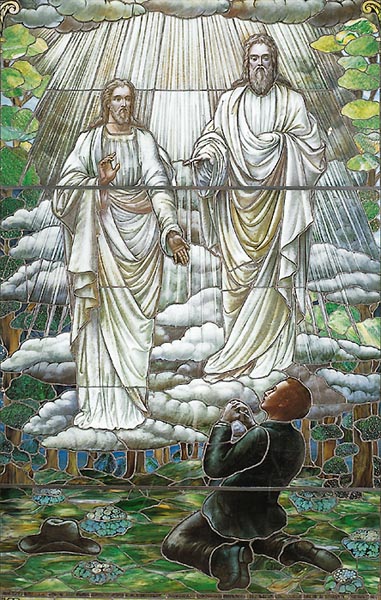
I think it is only in conversations with Mormons that I have seen the importance for our salvation that Jesus Christ "is the image of the invisible God" (Colossians 1:15). Because it is not unconnected that Joseph Smith said he saw the Father alongside the Son in a vision in 1820, and also denied that Christ's death and resurrection alone is sufficient for our salvation, or that the revelation of God in the Bible (which is all about Jesus!) alone is sufficient for us to know the Father fully.

It also makes me even more concerned than I was that Rublev's famous icon is not a wonderful celebration of the (Eastern) Orthodox understanding of the Trinity, but is actually an aberration which undermines our relationship with the true Trinity.... just to be a little controversial.

Friday, September 03, 2010

Riffing on the Creed

The creed is structured by the Trinity (Father, Son and Holy Spirit), and by the three acts of God (Creation, justification and sanctification). Luther summarises it:

in all three articles God himself has revealed and opened to us the most profound depths of his fatherly heart and his pure, unutterable love.

For this very purpose he

  1. created us,
  2. so that he might redeem us
  3. and make us holy,

and, moreover,

  1. having granted and bestowed upon us everything in heaven and on earth,
  2. he has also given us his Son
  3. and his Holy Spirit

      through whom he brings us to himself.

            For, as explained above, we could never come to recognize the Father's favor and grace were it not for the LORD Christ, who is a mirror of the Father's heart. Apart from him we see nothing but an angry and terrible judge. But neither could we know anything of Christ, had it not been revealed by the Holy Spirit.

(my formatting, pp.439-440, Martin Luther, "The Large Catechism" in The Book of Concord)

The Creed says Luther, tells us what God does in us as creator, redeemer and sanctifier. He creates us, justifies us and sanctifies us. He also gives to us the rest of creation, and himself in Jesus Christ and the Holy Spirit (all of which are distinct from us - but joined to us).

see this post

Friday, August 27, 2010

Four great links

All four move both your heart and mind.

Theologians are people for whom the Christian faith is especially difficult, incomprehensible, infuriating. As a rule they are not especially talented or spiritually adept individuals. They are people whose minds have been hurt by God, and they are restlessly searching (read more)

Gregory (Against Eunomius, 3.3) insists that only a Trinitarian theology can truly affirm the goodness of God. He assumes the Scriptural titles for the Son – light, truth, life, glory – and asks whether the Father could ever have been without these goods. If He was once without the Son, then He was once without these goods. God is good because God is Triune (read more)

What would you write to your suffering, struggling, almost compromising friend?

If you were the Apostle John writing under the inspiration of the Holy Spirit, you would write to him about God (read more)

By Faith from Keith and Kristyn Getty on Vimeo.