Sunday, October 22, 2006

Pragmatic Paul, or the Theologian of Tarsus?

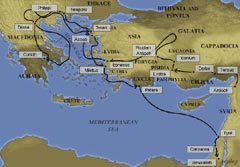
I have just had a thought going through my head for the last few days. How many times have you heard the observation on Paul's missionary journeys that he focused on cities because it would ensure the greatest impact? I.e. that by focusing on the cultural and economic centres of his day he would ensure that many people would hear the gospel and it would then spread out to the country from the bridgeheads he had developed. Tim Keller has put this best I think when he says that 'cities are where the culture is heading' and so we ought to focus our evangelism there, following the example of Paul. Essentially the consensus is that Paul was primarily a pragmatist in his choice of cities to visit.

However, I have a tentative theory to suggest. I'm sure it is not original but surprisingly I have never heard it put forward. I think Paul may have chosen to focus on cities, and particularly the cities that he did, because they were where Diaspora Jews lived. Then as now immigrant communities lived in the cities, and Paul was committed to the doctrine of 'the Jew first and also the Greek' (e.g. Rom 1:16). His evangelism was always (I can't think of an exception) begun in the synagogue of the city and he only left there either on invitation of 'God-fearing' Gentiles or after being forcefully expelled.

I have not yet met a Christian that seems to truly believe in the doctrine so central to the early church of 'to the Jew first', and I am no different. I suspect we are not half as theological as Paul was in our thoughts on all of life, including evangelism, and without knowing it we all read in our pragmatic disposition into the bible.

Saturday, October 14, 2006

Lost for words...

I would love to blog all that I am getting out of this book, but unlike the Apostle John will probably give up when faced with a challenge. It is definitely in the top couple of books I've read this year (although that is not saying much - 2006 has been a bad year).

Apparently Peter Leithart toyed with calling it Through New Eyes for Dummies, after James Jordan's book. Jordan's book is already on order from Amazon, I can barely wait.

John Stott interview

I love John Stott so much, and this interview encapsulates just about everything I love about him (HT Justin Taylor). Truly a model to emulate, and a teacher to learn from.

Friday, October 13, 2006

Freedom for 3 months!

I sat my final exam for my law module for this year with the OU. No more law for 3 months!

I just don't know what to do with myself, after so many months of hard work. 'suppose I'll catch up on some reading.

Thank God they went quite well - for a change. He is so gracious considering I am so lacking in dependence.

Wednesday, October 11, 2006

Quotable: The active and passive recipients of promise

I don't think I have read a quote which better sums up both the strength and weakness of Reformed theology so well. Following Simeon's test again - you could not find theology more exhalting to the Saviour, and humbling to the sinner; but the door for the sinner to ignore the promotion of holiness has been left ajar.

It is said, "the promise is made to the Seed," yet the promise is made to us, and yet again the covenant is made with Abraham: How can all these stand together? […] The promises that are made to us, though they be of the same covenant, nevertheless differ in this respect: the active part is committed to the Messiah, to the Seed himself, but the passive part consists of the promises made to us […] The meaning is that they are derivative promises. The primary and original promises were made to Jesus Christ.

(Preston, The New Covenant [ed. 1639], cited in p. 250, "The Doctrine of the Covenant in Reformed Theology", in Redemptive History and Biblical Interpretation: The Shorter Writings of Geerhardus Vos, ed. Richard B. Gaffin Jr.)

PS. I'd never heard of Preston but this is who he is.

Friday, October 06, 2006

Quotable: Leithart on justification

These are just a couple of quotes I wanted to note down from "'Judge Me, O God': Biblical Perspectives on Justification" by Peter Leithart. Both magnify the scale of God's saving (justifying) work, while reminding us that while it may have already been done, it is still not-yet.

It is true that God "reckons" or "considers" us righteous prior to His taking action on our behalf, and that "reckoning" is an act of sheer grace for the sake of Jesus. But that secret decision is not justification, any more than the decree to save the elect is the salvation of the elect. A judge may conclude that the accused is innocent, but his private conclusion does not constitute a legal decision. A legal decision must be promulgated as a decision of the court, and in many passages of Scripture, God’s public declaration of righteousness occurs when He "gives to the righteous according to His righteousness." God’s forensic declaration does not ring through the heavens while leaving earth in silence; rather, god’s declaration "He is righteous" affects the righteous in real time and real history. […]

Decades ago, Leon Morris wrote in his little book on The Biblical Doctrine of Judgment (1960) about the difference between modern and Hebraic conceptions of judgment. For moderns, to pass judgment means to weigh evidence and declare a sentence. Once the sentence has been passed, the judge’s job is finished, and someone other that the judge ensures that the sentence is carried out and that justice is actually done. In Scripture, however, judgment includes establishing justice as well as deciding what is just.

(pp. 212-213, Peter J. Leithart, "'Judge Me, O God': Biblical Perspectives on Justification" in The Federal Vision, ed. Steve Wilkins and Duane Garner)

The gospel really is a lot better news than bare 'forgiveness of sins'. I remember a John Piper sermon where he said: "forgiveness of sins... who cares right... I mean really?" (hopefully not too misquoted there).

In all of this, it is crucial to remember continually that justification, however defined, is by faith. And in part that means that our justification/vindication is not completely and fully revealed before the Last Judgment. We are justified in the present, but in another sense we await final public vindication. Many believers have been faithful to death, and their bones now lie in forgotten graves or scattered on the earth. God our Father, for His own infinitely wise reasons, did not intervene to rescue and justify them. But they are not forgotten, and someday they will rise to public vindication, while their enemies and accusers are silenced in darkness. Vindication may not be now; it may not be soon; but it will come. Or God is not God.

(pp. 231-232, ibid)

A sobering vision but a better hope than Rupert Brooke's which came to mind as I read it.

Quotable: Vos on the covenants

Quotes I wanted to record from the essay "The Doctrine of the Covenant in Reformed Theology" by Geerhardus Vos. I think they all pass Simeon's test too.

God does not exist because of man, but man because of God. This is what is written at the entrance of the temple of Reformed theology.

(pp. 242, "The Doctrine of the Covenant in Reformed Theology", in Redemptive History and Biblical Interpretation: The Shorter Writings of Geerhardus Vos, ed. Richard B. Gaffin Jr.)

[according to Lutheran theology] Precisely because mankind’s destination had already been reached before the fall in Adam, Christ can do nothing but restore what was lost in Adam. And since the destination already realized was fully compatible with mutability and the possibility of falling, the sinner who has been brought back to his destination by Christ must necessarily have to remain at this level. Lutheran theology is, therefore, wholly consistent when it teaches an apostasy of the saints. It does not at all object to uniting the state of justification and sonship with the possibility of such apostasy. […]

What we inherit in the second Adam is not restricted to what we lost in the first Adam: it is much rather the full realization of what the first Adam would have achieved for us had he remained unfallen and been confirmed in his state. Someone placed in that state can never again fall from it. As truly as Christ is a perfect Saviour, so truly must be bestow on us the perseverance of the saints.

(pp. 242-243, ibid)

I'd never heard these two doctrines connected before.

The obtaining of eternal life thus comes to lie in God, as a work that is Hs alone, in which His glory shines and of which nothing, without detracting from that glory, can be attributed to the creature. On this point the entire Reformation, both Lutheran and Calvinist, took exception to Rome, which failed to appreciate this fundamental truth. Yet the reasons which had driven both sides to this protest were different. With Luther it was the thirst for peace and stability for a restless conscience which could find no tranquillity in Rome’s salvation by works. As long as the sinner himself has to do something for his acquittal, his work remains unstable. Thus the sola fide became the shibboleth of the German Reformation, justification, its principle doctrine. One will agree that, despite all the purity with which this doctrine develops and in which, in developed form, it is given anew to the church, the highest point is still not reach, namely, that point from which the Scripture itself views the matter when, in the words of Paul, it sees the heart of Abraham’s faith in his “giving God the glory” (Rom 4:20). Even in its doctrine of justification Lutheranism did not catch hold of this idea in its fullness. Not a purely theological, but a partly anthropological motif ran through it. It was different with the Reformed. They, too, felt the same necessity to leave the waves of Rome’s salvation by works and once again stand on solid ground. But beside and behind this necessity there lay a deeper longing: a thirst for the glory of God that did not primarily meditate on its own peace. When the Reformed takes the obtaining of salvation completely out of man’s hands, he does this so that the glory which God gets from it might be uncurtailed. What is important for him is the realization that God glorifies Himself in the salvation of sinners, whereas the Lutheran is satisfied when it merely becomes evident that man brings nothing of his own instability into the picture. For the Reformed the center of gravity does not lie in justification as such, but in the principle by which the latter is to be judged and which the Scripture everywhere applies when it teaches us to regard the work of salvation in its totality as being exclusively a work of God.

(pp. 246-247, ibid)

According to the Lutheran, the Holy Spirit first generates faith in the sinner who temporarily still remains outside of union with Christ; then justification follows faith and only then, in turn, does the mystical union with the Mediator take place. Everything depends on this justification, which is losable, so that the believer only gets to see a little of the glory of grace and lives for the day, so to speak. The covenantal outlook is the reverse. One is first united to Christ, the Mediator of the covenant, by a mystical union, which finds its conscious recognition in faith. By this union with Christ all that is in Christ is simultaneously given. Faith embraces all this too; it not only grasps the instantaneous justification, but lays hold of Christ as Prophet, Priest and King, as his rich and full Messiah. The deepest reason for this difference in view is none other than the fact that the reception of the full glory of the work of God’s grace in the consciousness of faith is the most important thing to the Reformed believer.

(pp. 256-257, ibid)

Not sure about that last sentence though.

Carl Trueman on John Owen

I have found these lectures very thought-provoking over the last week (HT Justin Taylor):

• John Owen: The Man and His Time
• John Owen and the Practice of Theology
• John Owen on God
• John Owen on Christ
• John Owen on the Holy Spirit

It is not so much the content that has challenged me, but the passionate and enthralling picture of a way of doing theology that is quite alien to me, and that I have largely rejected.

Owen, in concert with most of the church throughout history, was very willing to be creative in his theology. Also in common with the historic church, he particularly enjoyed contemplating the nature of the Godhead. I have seen the danger of both these trajectories, but perhaps need to listen to the church more and contemplate their great helpfulness too. I will have to do some thinking on this.

Highly recommended anyway. Thank you Carl Trueman.

If Christ is a bridegroom...

Luther finds lots of wonderful implications from that metaphor.

…if Christ is a bridegroom, he must take upon himself the things which are his bride’s and bestow upon her the things that are his. If he gives her his body and very self, how shall he not give her all that is his? And if he takes the body of the bride, how shall he not take all that is hers?…

Christ is God and man in one person. He has neither sinned nor died and is not condemned and he cannot sin, die, or be condemned; his righteousness, life, and salvation are unconquerable, eternal omnipotent. By the wedding ring of faith he shares in the sins, death and pains of hell which are his bride’s…

Who then can fully appreciate what this royal marriage means? Who can understand the riches of the glory of this grace? Here this rich and divine bridegroom Christ marries this poor, wicked harlot, redeems her from all her evil, and adorns her with all his goodness. Her sins cannot now destroy her, since they are laid upon Christ and swallowed up by him. And she has that righteousness in Christ, her husband of which she may boast as of her own and which she can confidently display alongside her sins in the face of death and hell.

(from "the Freedom of a Christian," in Three Treatises, cited in p. 207 Leithart, Peter J., "'Judge Me, O God': Biblical Perspectives on Justification", in The Federal vision)

And amazingly there is plenty more in that metaphor if you think about it.