Friday, December 31, 2010

The King's English

The brilliant and unique Glen Scivener is spending 2011 celebrating the publication of the King James Bible in 1611 by starting another blog.

This is what he says about it:

This blog is just one attempt to raise awareness about the impact of this translation on the English speaking world. I will blog on a phrase per day that has passed into common parlance: popular phrases like “labour of love”, “beast of burden”, “wits’ end” and “scapegoat”; but also phrases that should be more popular, like “filthy lucre” and “gird up thy loins”.

This is a blog for people of all beliefs and I’ll try to keep things as jargon-free as possible. I hope that whether you are a Christian or not you will understand more about the English we speak, and about the King who has shaped it.

Most of my readers probably know about Glen's blogging already, but if you don't you're missing a treat. Unlike me Glen always has something to say and tends to say it well. But the best thing about Glen is that he is a man with just one king.

I'm looking forward to enjoying a constant flow of his grace-filled, provocative, passionate and fresh thoughts on all those phrases. Why not add his feed to your RSS reader and tell others about it as well?

My books of 2010

For what it is worth, my highly personal favourite books of the year were:

  1. Longing to Know: The Philosophy of Knowledge for Ordinary People by Esther L Meek
  2. The Living Word: A Theological Study of Preaching and the Church by Gustaf Wingren
  3. Counterfeit Gods: When the Empty Promises of Love, Money, and Power Let You Down by Timothy J Keller
  4. The Trellis and the Vine: The Ministry Mind-shift that Changes Everything by Colin Marshall and Tony Payne
  5. Perelandra by CS Lewis

Most of the books I read this year were pretty good. Unfortunately I read very little simply for myself because with my law course I didn't have the time. I think that meant that there were no books that were deeply personally significant this year. I read most of these books in order to discuss them with friends or pass on/recommend to others. None stand-out so much that I want to recommend any in particular.

I wish I had spent more time reading fiction and the Bible.

These are the books I read:

Crazy Love (Chan) – Like John Piper’s Don’t Waste Your Life but more focus on love for your neighbour. Perhaps could do with a stronger emphasis on our forgiveness, but I think it is a good thing that this kind of book is a Christian bestseller.

Experiencing the Trinity (Johnson) – A very short introduction to the doctrine of the Trinity. Pretty good although I’m still looking for a good introductory book to the doctrine.

Man and the Incarnation (Wingren) – A book by a Swedish Lutheran on Ireanaus. Particularly emphasising God’s continual creating activity, and our corresponding continual growth into Christ in whose image we are made.

Theology is for Proclamation (Forde) – Forde has a big idea, and it is a good one. In this wide-ranging critique he argues we should evaluate our theology by whether it leads to proclamation. He finds almost all orthodox theologising as lacking, but I didn’t feel like he had really thought through most of his critiques. I think he was just over-ambitious, and over-critical.

The Waiting Father (Thielicke) – A collection of sermons on the parables. I don’t think I’ve ever read such an amazing rhetorician, and then it is all backed by a first-rate theological mind. The down-side was that I was not always certain he was exegeting the text itself.

Letters to a Young Calvinist (Smith) – a very snappily written encouragement to soteriological Calvinists to widen their vision and embrace something more like neo-Calvinism. I thought this was a really great book.

Distinctives (Roberts) – we read this as a home group. I think we were all encouraged to have a bit perspective, and realised how radically that should affect our lives.

The Death of Ivan Ilyich (Tolstoy) – a dark short story about the dying of a stereotypical middle-class man who could have been around today. Vanity, all is vanity!

The Unquenchable Flame (Reeves) – an excellent introduction to the Reformation as expected (see my review note).

Gilead (Robinson) – Everyone says you should read it, and they are right. Gilead is a beautiful illustration of what it means to live and die well. Especially if read in comparison to Ivan Ilyich.

The Temple and the Church's Mission (Beale) – A ponderous book, but with a great central thesis that is probably a lot more controversial in the States than the UK. God intended for Eden to be a temple that would expand and fill the whole world with his presence through the work of humanity. The church, in Christ, picks up the task.

That Hideous Strength (Lewis) – Volume 3 of the Space Trilogy. I enjoyed this the most of all three, although it was probably the least ambitious.

What is the Gospel? (Gilbert) – I don’t like the fact that he included 'response' within his definition of the Gospel. But as a short, accessible and punchy explanation of what ought to be at the forefront of the Church’s teaching I thought it was very well executed.

The Trellis and the Vine (Marshall and Payne) – Argues that one-to-one ministry from the very top-down is essential in growing a church in character, conviction and competency. The central metaphor is important, and I am thoroughly convinced that churches ought to adopt this remarkably simple and word-centred model of ministry. I blogged a little on it.

Perelandra (Lewis) – the second volume of the space trilogy. Lewis attempts to describe the interaction between an unfallen woman, a fallen man and the devil. Very illuminating about temptation, and exposes much of how we assume that ‘sin’ is just the way things are.

Longing to Know (Meek) – a weird book that slips between quite mind-bending philosophy of knowledge and homey illustrations. But I learnt a lot about how we know, and how that applies to our knowledge of God and assurance. The trouble is, and the author will be unsurprised by this, a lot of what I learnt is difficult to express.

Life Together (Bonhoeffer) – a deserved classic which I read for the second time. Compact, practical and challenging. However, I continue to have a nagging doubt about Bonhoeffer. Everyone loves him and rates Discipleship and this book among their favourites, but if you asked me, or anyone else how he changed them I think most would struggle to say anything concrete.

Out of the Silent Planet (Lewis) – the first of the space trilogy. I don’t think this is the best but it sets up the rest of the series.

The Living Word (Wingren) – a powerful polemic for the life-creating power of the preached word and the significance of conflict with the devil.

He Is There and He Is Not Silent (Schaeffer) – I’m afraid I just don’t think I get Schaeffer. He paints with a broad brush over a huge canvas. I like what he is trying to do, but he doesn’t persuade me of anything.

Escape from Reason (Schaeffer) – as above. I feel I ought to love Schaeffer. My pastor is a fanatic. Perhaps I should read something more substantial.

A Sinner's Guide to Holiness (Chapman) – a short booklet on sanctification. Realistic, it was helpful for a friend in explaining the importance and difficulty of holiness in this life.

What Kind of God? (Ots) – This is best book I’ve come across at answering these kinds of questions. I wouldn’t hesitate to give this to someone who is not yet a Christian.

Friendship (Black) – A Victorian book on the importance of friendship. Vaguely Christian, but very perceptive. Reminded me a little of Lewis.

Counterfeit Gods (Keller) – I have been thinking about idolatry all year because this book stuck with me and was augmented by listening to his sermons and the influence that Keller is on friends. I have lived with the challenge and the hope of a better God in Christ all year, and I’m very thankful for that.

Proper Confidence (Newbigin) – Short book of lectures from the end of his life, it is therefore perhaps unsurprising that it is not very tightly written. Newbigin argues for the correct kind of confidence we should have in our faith.

The Reason for God (Keller) – Need I say anything? Second time I read it and enjoyed it as much as the first time. Every Christian should read this book. I don’t think it is good for giving away, but Keller is the best model I know of for thoughtfully dealing with real questions people are asking today.

The Theme of the Pentateuch (Clines) – This was a seminal book for OT studies, and like most seminal books you can see why as soon as you read it. I summarised some of it.

Doubt in Perspective (McGrath) –This is very good short book to give someone who is doubting. It is accessible and short, but goes quite deep.

I'm a Christian, aren't I? (Clark) – I’m sorry but I think this is the only truly bad book I read this year. It is written for nominal Anglicans, but I think it destroys both true and false assurance.

Just Love (Cooper) – I reviewed this here. A good book on the validity of divine retribution, that doesn’t neglect the Gospel.

Some books of the year lists

All the end of year reviews have collectively persuaded me that to read The God who is There: Finding Your Place in God's Story by Don Carson, and Bonhoeffer: Pastor, Martyr, Prophet, Spy by Eric Metaxas. Despite their best efforts I will resist the collective wisdom to read the doubtlessly excellent To Change the World: The Irony, Tragedy, and Possibility of Christianity in the Late Modern World by James Davison Hunter and Defending Constantine. The Twilight of an Empire and the Dawn of Christendom by Peter J. Leithart.

.

Dissecting a frog, and Karl Barth

Analyzing humor is like dissecting a frog. Few people are interested and the frog dies of it." (EB White)

I had a rather surreal conversation with a friend the other day about whether God had a sense of humour. I didn’t really come to a firm conclusion, but I tried to think through what humour actually was and think that it must be something like:

1. An awareness of incongruity

built upon

2. A foundation of optimism

I feel that things don't fit and surprise us because as finite beings we are always engaging with a world much greater than we can ever comprehend fully. Even our own bodies and minds surprise us and amuse us (especially if you are a dad, or slowly becoming your dad, at Christmas).

Good humour is attractive in someone because it shows a combination of both humility (on account of their finitude) and cheerfulness (on account of their optimism). Sadly, often as people we are either humble and afraid, or happy and arrogant.

I was prompted to post on this when reading TF Torrance describing the importance of Karl Barth's sense of humour:

"He was able to laugh at himself, and therefore to criticise himself, and hence to direct even ruthless critique at others in such a way that he could appreciate their intention and respect their persons and their sincerity. In this respect he stood out in marked contrast to the seriousness with which nineteenth century man took himself [...]

The Christian church has no right to despair of 'this weary world' or to be afraid it will crumble away into nothing. Christ is risen! [...] In him we can lift up our heads and laugh in the face of disaster and death… The Christian is the only one with a genuine message of hope and is the one true optimist." (pp.12-13, 23, TF Torrance, Karl Barth: Biblical and Evangelical Theologian)

PS The Wikipedia article on the theory of humour is interesting.

PPS For what it’s worth I tentatively think that while God is full of joy and he tells countless jokes in his creation/redemption, he doesn’t actually have a sense of humour for himself because it is a creaturely characteristic. As the infinite creator the only thing that doesn’t fit in his world is sin, so God laughs at sin (Psalm 2:4 etc) but at nothing else I’m aware of. Although I don’t think that is because he finds sin humourous in the truest sense of the word (which I admit is beyond my grasp!). However theoretically, perhaps as the initiator within the Trinity the Father can surprise the Son, so the Son laughs at jokes told by his Father. But I am far beyond my knowledge. Does anyone know of anything in the Bible to give more of a clue?

PPPS more on comedy try CS Lewis (who I think I got the idea of incongruity from) and Glen Scrivener.

Wednesday, December 29, 2010

Christological titles and stories

Listening to: Balmorhea: Constellations

Prompted, but not in response to, Chris's blog (go read it). This post is largely a riff on Gerhard Forde's argument in pp.62-67 of Theology is for Proclamation, which is where the quotes are from unless otherwise stated. I haven't really thought it all through so please pick holes.

Jesus' question in Mark 8 "Who do you say that I am?" is a question that Jesus cannot answer directly. "Traditionally", Forde says, "titles cannot be self-designations" (cf. John 8:54: "If I glorify myself, my glory is nothing"). Therefore Jesus only makes "an implied christological claim", and "does not speak of himself openly and directly".

Instead he puts others "on the spot to speak for" themselves. As soon as we start to talk about Jesus we find that the question of what title to give him is "inevitable". "We are called upon [like Peter was] to make explicit what was implicit in him".

There are two inter-related dangers in this:

The first danger is that we rewrite the story to fit what the title means in our culture.

Every new title brings with it its own world of meaning, its own story. Inevitably pressure is exerted in countless subtle ways to rewrite the story to fit the title [...] Perhaps that is why the Jesus of the Gospels either refuses the titles or wants them kept secret. The story is not yet over and all the fine titles press toward a different end.

To avoid this danger "the title must be transformed to fit the [true] story." I.e. language, and the culture expressed in language, must be 'redeemed'. But Jesus will ensure that this happens. In his church it will happen in part now and universally it will happen in the future when "every tongue confess[es] that Jesus Christ is Lord".

Most evangelicals today think that content is all that matters and that the form and mediums we use to express it (e.g. the style of music, venues, the language we use) are insignificant. Jamie Smith, sees this as naive and criticises evangelicalism for:

unwittingly reducing Jesus to one more commodity precisely because, in the name of "relevance," they've adopted a worship "style" that simply mimics the mall. Since ... the form/content distinction is specious, you can't simply take Gospel "content" and drop it into the "form" of the mall's worship because that form is already loaded and primed to another end or telos. This doesn't make the the church relevant; it reduces Jesus to a commodity.

However, this wise caution about Jesus being co-opted to serve another end can go to an extreme which is a lack of confidence in the power of the Word to transform what seems unredeemable by the Holy Spirit. Luther and Melanchthon in the 16th century would justify themselves before more radical reformers for being slow to reform the liturgies of the church because they were confident that as long as the Gospel was preached it had power enough to transform everything else. It has the power, and God's promise, to burst out of any constraints placed upon it.

We should find a middle road of confidence but not complacency that is realistic about both the power of the Devil and the power of God over our language and liturgies.

The second danger is that we rewrite the story to fit what we, personally, would like the title to mean.

The hearer, it should be realized, has a stake in the giving of titles. The title represents dreams and hopes: the final ratification of our aspirations; a judge who will finally give evildoers their comeuppance; a Messiah, a Christ who will finally do in all the enemies; a Son of God who will be a universal ruler; a liberator; a man for others; one in whom God-conciousness reaches its zenith [...] We would like nothing better than that all our dreams, without alteration, should be realized in him.

To avoid this danger we must be changed by the title. With Jesus' question "who do you say I am?" we are "drawn into the story" and either it is fitted to us or we are moulded by it. Our dreams and our loves have to be reshaped by the story of Jesus, so that we long to see God face-to-face, we hate evil and love communion with God and his church.

This need for change of the culture and ourselves (not that you can separate the two) cannot be avoided because Jesus will be king, and not let titles rule him. It is also a radical change of death and new-birth. That is why Jesus follows Peter's confession and rebuke with the statement that "if anyone would come after me, let him deny himself and take up his cross and follow me."

We have to reach the "end of our story". We are drawn into Jesus' story by the confession, and if we cannot shape it around ourselves then we will be shaped by Jesus' story of death and resurrection.

Monday, December 27, 2010

Is this right?

The Father serves the Son. The Son serves the Father.. The circle is the circle of servanthood." (my italics, p. 80, Darrell W. Johnson, Experiencing the Trinity)

I know some of my readers know their Trinitarian theology better than me, but I cannot think of a verse that would suggest that the Father serves the Son. Certainly, the Son glorifies the Father and the Father glorifies the Son (although even that is not simply circular I don't think). Also the Father gives (life) to the Son. But doesn't the Son obey the Father and not vice versa?

Friday, December 24, 2010

Who adminsters baptism?

Probably one of the biggest questions to ask about baptism is:

  • Is baptism primarily an act of, or upon, the person baptised?

Interesting to hear what a Baptist scholar may say about that based on the evidence...

Some Jewish groups practised 'proselyte baptism', i.e. proselytes were baptized in the process of converting to Judaism. In the monastic community at Qumram, members invoked passages such as Ezekiel 36:25 to justify their daily baptism... But in both instances baptism was self-administered. Candidates baptized themselves... One of the things that characterized the baptism of John the Baptist is that he himself administered it. It may even be that the authority implicit in such an innovative step triggered the assumption in the minds of at least some Pharisees that John's baptism was an end-time rite administered by an end-time figure with great authority.

(italics original, p.145, DA Carson, The Gospel According to John)

Carson notices that if baptism is primarily something done by one with authority to the person baptised there is a secondary question of who has such authority. John Calvin suggests an answer in commenting on John 4:2 where the Evangelist says that Jesus baptised, and yet also clarifies that it was only his disciples who did the action:

He gives the designation of Christ’s Baptism to that which he conferred by the hands of other, in order to inform us that Baptism ought not to be estimated by the person of the minister, but that its power depends entirely on its Author, in whose name, and by whose authority, it is conferred. Hence we derive a remarkable consolation, when we know that our baptism has no less efficacy to wash and renew us, than if it had been given by the hand of the Son of God.

PS I am sorry. I know that Christmas Eve is probably not the time to riding one of my hobby-horses.

Thursday, December 23, 2010

Some thoughts on Wisdom in Proverbs

I have often felt that wisdom is a rare, unobtainable thing. I wonder if wisdom, at least for me, is more precious than gold because it is less easy to come by. But at the same time as feeling that I've felt that Proverbs is a book which is largely made up of banal commonsensical observations on how the world works!

If I read Proverbs properly I'd have got a different impression.

"Wisdom calls aloud in the street, she raises her voice in the public squares; at the head of the noisy streets she cries out" (1:21). There are lots of competing voices in the world but you don't have to seek wisdom out. It is not some secret knowledge (Gnosis) that you have to climb a mountain to get to. It is actually obvious that the good life involves thinking before speaking, working hard, being generous, being honest, even fearing God. This is what wisdom is.

If access to wisdom is not what makes you wise. Google will not make us stupid, but it doesn't make us wise either. The distinction between the wise and the stupid is that wisdom "rests in the heart of a man of understanding", whereas it is only "known ... in the midst of fools" (14:33).

However it is still the mark of a wise man that he is continually desiring to "hear and increase in learning" because he doesn't possess wisdom in the complete way that God does. How often are we forced to remember that "a man's steps are from the Lord; how then can man understand his way?"

A wise man's approach will be distinguished by the following::

  • He starts with the LORD - fearing him (1:7, 14:27, 22:4, 29:25), listening to him (2:6, 3:11-12), trusting him (3:5, 16:20, 28:25) knowing the wisdom belongs to him (8:22f).
  • He listens to the right people - to his parents and not the attractive woman (1:8, 4:1, 15:5, 23:22; 2:16, 6:24), to many people and not just himself (11:14, 12:15, 15:22), to the righteous and not the wicked (10:11, 12:26, 13:20, 14:7, 15:2).
  • He listens humbly - accepting of reproof and discipline (11:2, 13:10, 15:31, 19:25, 27:6) and beware of flattery (29:5).
  • He listens thoughtfully - he is not uncritical of advice (14:15, 18:17).

So what has this to do with Christ, "our wisdom" (1 Cor 1:24)?

  • We will honour his uniqueness. We know that only he possesses complete wisdom, and every human is just a creature who is continually growing in wisdom but never reaching completeness. Our wisdom is further corrupted by our sinfullness so we should be humble and accepting of rebuke not just additional teaching.
  • We will look to him to receive wisdom from his hands. We will listen to the Bible. We will pray to him to give us more wisdom (1 Kings 3:1-15, James 1:5). We will listen to the righteous who are his ambassadors on earth who as his disciples learn from him and pass on what he teaches.

NB there is some overlap with what Newbigin has to say about certainty.

Wednesday, December 22, 2010

Everything in Christ poured into this moment by his Spirit

Listening to: Radiohead: The Bends

The deed of proclamation in the living present is the deed of the living God! It is what God has in mind for us. The mighty acts of God are not over, not relegated to the past ...Everything that God has done in Jesus Christ has been poured into this moment. The incarnation, death, and resurrection of the Son of God in Jesus is the authorization for the proclamation of the will of God in the living present. The preacher needs the "nerve" - the Spirit - to act on that...

The preacher acts on the presupposition that only the present-tense, here-and-now deed of God, the proclamation itself, can be the solution to the problem of God. The proclamation is the end result, the culmination, of the great acts of God in history. The preacher ought to have the consciousness of standing in that place knowing that the Word and sacrament are themselves the end (telos), the purpose of it all. The concrete moment of the proclamation is the doing of the mighty act of God in the living present.

(pp. 30-35, Gerhard Forde, Theology is for Proclamation)

I'd qualify whether the Word and sacrament are "the end", otherwise we are over-realizing our eschatology. We must not forget that the glory is still hidden with Christ in God until the he is revealed in power and we are revealed as sons in our bodily resurrection.

I love that phrase: "Everything that God has done in Jesus Christ has been poured into this moment". Perfect! But don't you want to add something? That poured into our hearts by hearing through our ears and consuming by the mouth, the Spirit of Christ is bursting to be revealed - to transform us from the inside out in holy lives in the present and glorify our bodies when Christ comes again so that the whole world gives God the glory.

Systematic theology

"I take systematic theology, therefore, to be the kind of reflection that takes place between yesterday's and today's proclamation. One who hears the proclamation reflects on it so as to say it again in a different time and context. It is a reflection that takes place between the ear and the mouth." (p.4, Gerhard Forde, Theology is for Proclamation)

If that is the case then good systematic theology will be:

  1. Listening to the Bible obediently and attentively.
  2. "not only [leaving] room for proclamation but [making] the move inescapable" (p.5)

The right kind of certainty

Lesslie Newbigin finds in 2 Timothy 1:12 the right kind of certainty that Christians should have about their faith:

"I know whom I have believed, and I am convinced that he is able to guard until that Day what has been entrusted to me."

He observes that there three aspects of this kind of certainty:

  1. Certainty rests not in the competence of my knowledge, but in the faithfulness of the one whom I know.
  2. It is something in via. I don't possess it. I am on my way to it. I am looking forward to that day when it will be fully known to me.
  3. It is a matter of grace ("What has entrusted to me")

Tuesday, December 21, 2010

Be born in us today

Sarah and Rebekah were both barren women who God miraculously provided sons, in accordance with the promise given to Abraham for a Seed.

God trumps both in Mary, to whom he gives a son despite her being a virgin! He was THE promised Seed (singular) of Abraham, which the others were only shadows of.

I blogged about this series of shadows to Mary 3 years ago. But yesterday evening I came across whatever the opposite of a shadow is - reflected light?!

"Rejoice, O barren one who does not bear;
break forth and cry aloud, you who are not in labour!
For the children of the desolate one will be more
than those of the one who has a husband." (Gal 4:27 quoting Is 54:1)

Who is this barren woman? For Isaiah it was the land of Israel and Jerusalem that was the inheritance of the people of God. For Paul it is "the Jerusalem above" that is the inheritance of the church. She like Sarah, Rebekah and Mary also gives birth to "children of promise...according to the Spirit" (4:28-29). That is us when we are born again and "Christ is formed in [us]" though the "anguish of childbirth".

O holy Child of Bethlehem,
descend to us, we pray;
Cast out our sin, and enter in,
be born in us today.
We hear the Christmas angels
the great glad tidings tell;
O come to us, abide with us,
our Lord Emmanuel!

Who do you want to see in the Kingdom of God?

"the works of the flesh are evident: sexual immorality, impurity, sensuality, idolatry, sorcery, enmity, strife, jealousy, fits of anger, rivalries, dissensions, divisions, envy, drunkenness, orgies, and things like these. I warn you, as I warned you before, that those who do such things will not inherit the kingdom of God." (Galatians 5:19-21)

Recently our home group studied this passage. Everyone there knew that they ticked one of the boxes so the plain reading of the text was that they would not inherit the kingdom of God. But it was the newer Christian who asked the obvious question: "How can that be true?"

Faced with that stark piece of 'law' the various 'answers' suggested were perhaps inevitable:

  • Perhaps it meant "continue in such things" - so as long as you don't carry on doing such things you'll inherit the kingdom.
  • Or perhaps it meant those whose life is "characterised by such things" won't inherit - you may do them, but they are just flashes in the pans when they happen.

It was a rather stark series of attempts to blunt the force of the 'law', which perhaps had missed the equally stark word in verse 24: "crucified". Sin leads to death and there is no way round that because God will never allow 'sinners' in his kingdom. And if a 'sinner' is all we are then it is an understandable defence mechanism to try and soften the sentence and find a way to sneak past the guards.

BUT, if we are also 'saints' by faith in Christ Jesus, then we don't care what happens to us as 'sinners'. In fact we rejoice over our death on Good (!) Friday 2000 years ago, in baptism a short while back, now (when we join in our own crucifixion of our desires and do not mind a little suffering!), and in our physical death in the future.

'Dave the Sinner' has no inheritance in the Kingdom of God. Great! I don't want to see him there frankly. I know he won't like the music or the company anyway.

Just as the plagues on Egypt meant freedom for Israel, so the death of the old me means life for the new me. In awareness of that we can welcome God's judgement - not blunt it - even as it comes down on us!

Saturday, December 18, 2010

Rutherford House Audio

Rutherford House has put up quite a few old tapes in MP3 format. I think they'd appreciate donations for the cost of the bandwidth. Speakers include:

  • Jim Packer
  • Ed Clowney
  • Don Carson
  • Donald MacLeod
  • Sinclair Ferguson
  • Carl Henry
  • David Jackman
  • Dick Lucas
  • John Piper
  • Dale Ralph Davis
  • Tim Keller
  • Ravi Zacharius
  • Peter Adam
  • Tom Torrance
  • Lesslie Newbigin and many more worth mentioning, but this list is already too long!

We do have an embarassement of riches these days on the internet. I'm listening to Sigur Ros instead though!

Lesslie Newbigin MP3s

Thomas F Torrance MP3s

This is all I know about (let me know if you know anymore):

Monday, December 13, 2010

Gifted response

I was searching for reviews, or even a contents page(!), for a book called Gifted Response: The Triune God as the Causative Agency of Our Responsive Worship, by Dennis Ngien, and instead Google told me about this verse from a Matt Redman song I didn't know:

This is a gifted response
Father, we cannot come to You by our own merit
We will come in the name of Your Son
As He glorifies You and in the power of Your Spirit

I like surprises....Every line of that song is worth its weight in gold.

Matt Redman has clearly been reading some good books, but not Dennis Ngien's as that was published later than the song. So who then?

This is lazy blogging at the moment!

Sunday, December 12, 2010

A sprinkling of MP3s

In some neglected corners of the web I've found a few unique talks that others may be interested in:

  1. Speaking To, Of, and For the Triune God by Robert Jenson (at the 2010 Lutheran CORE Theological Conference)
  2. God's Decision and Our Decision by Gerhard Forde (at Mount Carmel Ministries)

Tuesday, December 07, 2010

Caspar David Friedrich and the curse of Romanticism

Caspar David Friedrich is one of my favourite artists. He had a Romantic and, at first glance, seductive desire to find God in nature. If you described what he tried to do it would seem attractive, but if you actually tried to live that life you would find what he found... that in trying to find God apart from in Jesus Christ you will always find both common grace and the universal curse on the ground, and so you'll be constantly bouncing between happiness and despair.

Only in Jesus Christ can you make a decsive shift and break from the curse to new life and happiness.

The trouble is that when you develop the creed of a personal religion to the extent that he did, so that every day he had to recreate his experience of God - re-find his experience of divinity before nature - it placed such a burden on the individual as to be almost impossible to sustain. Yes, on a good day, Friedrich could find God in a radiant evening sky but on so many other days the vision didn’t come, all he could see was darkness, death even a kind of anguish. I think that Friedrich set out to be a painter of a new kind of Christianity but I think what he really created was a very moving series of monuments to an age of deep, deep anxiety.

(Andrew Graham-Dixon, The Art of Germany, Episode 2, BBC4, 6 December 2010)

Thursday, November 04, 2010

What I am up to

I'm off to the Lakes for a week with friends where I'll enjoy this view from our sitting room.

Unfortunately the weather will probably be slightly less pleasant in November and I've got to bring some law to study because I'm so far behind, but please pray it will be a good break and time of 'fellowship'. I'm confident it will be both.

Blogging will probably be light even when I get back though as things are busy, busy.

Things I would appreciate you praying for if you ever feel like it would be time to do Training Contract applications and organisation of a carol service for York lawyers, and then fruit from both (in particular: on the practical front we need a choir for the carol service and more importantly, with or without a choir, we'd like to see people come and then come to Christ).

Thank you everyone.

Wednesday, November 03, 2010

A few notes on parallels in Matthew's account of Judas' death

This post is basically a plea for help interpreting this passage:

Then when Judas, his betrayer, saw that Jesus was condemned, he changed his mind and brought back the thirty pieces of silver to the chief priests and the elders, saying, "I have sinned by betraying innocent blood." They said, "What is that to us? See to it yourself." And throwing down the pieces of silver into the temple, he departed, and he went and hanged himself. But the chief priests, taking the pieces of silver, said, "It is not lawful to put them into the treasury, since it is blood money." So they took counsel and bought with them the potter's field as a burial place for strangers. Therefore that field has been called the Field of Blood to this day. Then was fulfilled what had been spoken by the prophet Jeremiah, saying, "And they took the thirty pieces of silver, the price of him on whom a price had been set by some of the sons of Israel, and they gave them for the potter's field, as the Lord directed me."

(Matthew 27:3-10)

1. Jesus and Judas, David and Ahithophel

Jesus is of course the new David, who was betrayed just as David was. Perhaps the worst betrayal for David was of his son Absalom, and of his chief advisor Ahithophel to Absalom's side. Ahithophel's advice is ignored by Absalom in favour of Hushai's, David's mole in Absalom's court, and his response is extreme. He

"saddled his donkey and went off home to his own city. He set his house in order and hanged himself, and he died and was buried in the tomb of his father." (2 Samuel 17:23)

This is must be an intended allusion I think. The parallel is so strong. Any thoughts on its significance? In particular any thoughts on whether it helps us understand the differences between Luke and Matthew's account of Judas' death?

2. The field at Anathoth and the field of blood

Most commentators seem to think that the reference to Jeremiah is a mistake (e.g. Calvin: "The passage itself plainly shows that the name of Jeremiah has been put down by mistake, instead of Zechariah, (11:13) for in Jeremiah we find nothing of this sort, nor any thing that even approaches to it[!]"). However, some point out a possible parallel in Jeremiah 32 but don't really make anything it. I do think Jeremiah 32 is likely to have been in Matthew's mind just as much as Zechariah:

Jeremiah said, "The word of the Lord came to me: Behold, Hanamel the son of Shallum your uncle will come to you and say, 'Buy my field that is at Anathoth, for the right of redemption by purchase is yours.'...

And I bought the field at Anathoth from Hanamel my cousin, and weighed out the money to him, seventeen shekels of silver....For thus says the Lord of hosts, the God of Israel: Houses and fields and vineyards shall again be bought in this land

Zechariah 11 mentions thirty pieces of silver, the potter and the throwing of the silver into the temple. Jeremiah mentions silver and the purchase of a field. However I just can't see what Matthew is trying to say by drawing the parallel with Jeremiah. Jeremiah is a passage filled with hope, as Jeremiah is investing in the land because he trusts God's promises. But the priests buying the field of blood... I don't have a clue. Any help?

Saturday, October 30, 2010

Review note on 'The Unquenchable Flame'

Some thoughts on Mike Reeves' book The Unquenchable Flame: Introducing the Reformation:

1. In common with many introductory books it is short, easy to read and accessibly produced with pictures and boxes focussing on one thing or another. It covers an lot of ground very quickly. But unlike many introductory books it is infused with the character of the author. It is lively, occasionally funny and never dry.

2. It is passionate and clear about the central issue of the Reformation being our justification before God, but is it not hagiographic and is weighs up the strengths and weaknesses of every actor in the drama.

3. Some history books are so stuck in the past that they have nothing to say to today. Others just use the history to grind their own axes. Reeves seems to simply love spending time with these characters, but he never looses sight of his reader and is always inviting them into the story, and ends the book showing why we should still listen to the Gospel of the Reformers:

“[it is into our] context that Luther’s solution rings out as such happy and relevant news. For, having jettisoned the idea that we might ever be guilty before God, and therefore need his justification, our culture has succumbed to the old problem of guilt in subtler ways that it has no means to answer. Today we are all bombarded with the message that we will be more loved when we make ourselves more attractive. It may not be God-related, and yet it is still a religion of works, and one that is deeply embedded. For that, the Reformation has the most sparkling good news. As Luther put it: ‘sinners are attractive because they are loved; they are not loved because they are attractive.’ Only this message of the counter-intuitive love of Christ offers a serious solution.

A profoundly relevant beautiful and sweet message, a joy-giving message, a death-defying message: it is no wonder Richard Sibbes called the Reformation ‘that fire which all the world shall never be able to quench’.”

Why read about the Reformation?

Sunday is the 493rd anniversary of Martin Luther nailing 95 theses to the door of the church in Wittenberg. So why should we care? And more particularly why should we bother reading about the events of the Reformation and the writings of the Reformers?

1. It is OUR history

The church historian, Owen Chadwick once said: "Nothing is sadder than someone who has lost his memory, and the church which has lost its memory is in the same state of senility."

Reading about the Reformation is an act of remembering our history, and particularly the history of God's works in us. We can see the Reformation is OUR history because it shaped the church we are today more than anything else. For example:

  • Songs we've sung - congregational singing because the Reformers taught every Christian is a priest
  • Language we speak - English rather than Latin because they taught we cannot exercise faith in something we don't understand
  • Prominence of the sermon in our service - because they taught faith comes by hearing the Word of God
  • Our prayers addressed to our Father directly - because they taught we can approach him directly through Christ.

All these developments were based on a conviction about what the Gospel was, and it was this conviction that drove the Reformation.

But this wasn't ivory tower thinking. The Reformers were also working in a period of enormous political turmoil, which was often reflected in their personal lives.  Wars were fought because of the teachings and practices of the church.  Almost all the major Reformers were exiled from their homes, many lived under the shadow of death, and a considerable number paid the ultimate price for confessing the 'discoveries' they had made.  Most lost children and many suffered with long-standing and painful medical conditions.  It is not surprising that many believed they were living in the very last days.

Interesting times demanded characters to match, and there was no one type of Reformer.  Luther brewed his own beer and Calvin restricted himself to little more than one meal a day.

By any standards it is one of the most fascinating times to read about, packed with wonderful characters.

But the Reformation is not just history.  The actions and writings of the Reformers speak powerfully to us now, and we need to hear their voice.

2. Radical criticism for us

The German theologian Bonhoeffer was executed by Nazis supported by many people within the church.  He once famously commented that American Christianity was “Protestantism without the Reformation” - a phrase calculated to cause some head-scratching!  What the American church was missing in his eyes was a grounding in Jesus Christ who brought “radical judgment” and “radical forgiveness” to the church. He thought the Reformation was what offered that.

So what is the “radical judgment” that the Reformation offers us?

The US company Enron, and more recently the UK banks have shown the need for us to question whether things are always as good as we think they are.  When the shiny facade was stripped away in the financial crisis, what was left behind was not a pretty sight.  At the midweek meeting this week we looked at Ezekiel where God revealed that behind Israel's religiosity was idolatry.  In this evening’s reading from Galatians 2, Peter’s sensitivity to the concerns of the Circumcision Party are revealed to be motivated by fear of man.

Bonhoeffer believed that in the Reformation we learn “that God’s ‘criticism’ touches even religion, the Christianity of the churches and the sanctification of Christians, and that God has founded his church beyond religion and beyond ethics”.

The Reformers believed that God’s word calls into question the church itself and called the church itself to repent even of it’s ‘good works’.  They had a penetrating vision able to see things for what they were which, if we want to avoid being an individuals and a church that is beyond criticism, we would do well to appropriate for ourselves. 

3. Radical forgiveness and joy to share with us

When Luther plumbed the depths of his own sin in the monastery he found that it went so deep that he had to spend hours a day confessing to his mentor, but he still knew he hadn’t reached the bottom.

But almost like the Psalmist in Psalm 139 he found that Jesus Christ could be found even there! In fact, that was the only place that the one who died the shameful death of a condemned man could be found.

That is why it would be wrong to read the Reformers and stop with their blistering condemnations of sin, because the destination they had in mind was never hell, but heaven with Jesus.

The people of Geneva re-minted their coins following the Reformation of their city with the motto “After darkness, light”, such was the contrast they saw between their former faith and that which they now enjoyed. CS Lewis compared the Reformers' experience to waking from a “nightmare into ecstasy” and Martin Luther described his experience as “entering paradise itself through open gates”.

To read about their lives, and read their words is a little window into a kind of weighty joy that I long to taste more of. In knowing that they are utterly free from any hold over them by the devil or the penalty of sin, they had a confidence in the face of persecution, but more than that, a confidence in the face of God.

Once Luther, along with many others, feared to approach God directly and only prayed to saints to intercede on his behalf. But having rediscovered the doctrine of justification by faith, he and those that followed after him boldly lived lives of familiarity with God through Christ.

So ultimately we should read about the Reformation to share in their joy by knowing more deeply the grace of the Gospel God and our Lord Jesus Christ as it is found in the Scriptures.

Christ in all the scriptures

For what still sublimer thing can remain hidden in the Scriptures, now that the seals have been broken, the stone rolled from the door of the sepulcher (Matt. 27:66; 28:2), and the supreme mystery brought to light, namely that Christ the Son of God has been made man, that God is three and one, that Christ has suffered for us and is to reign eternally? Are not these things known and sung even in the highways and byways? Take Christ our of the Scriptures, and what will you find left in them?

(p. 110, Martin Luther, Bondage of the Will)

John Calvin picks up the baton and shows how that works out:

He is Isaac, the beloved Son of the Father who was offered as a sacrifice, but nevertheless did not succumb to the power of death.

He is Jacob the watchful shepherd who has such great care for the sheep which he guards.

He is the good and compassionate brother Joseph, who in his glory was not ashamed to acknowledge his brothers, however lowly their condition.

He is the great sacrificer and bishop Melchizedek, who has offered an eternal sacrifice once for all.

He is the sovereign lawgiver Moses, writing His law on the tables of our hearts by His Spirit.

He is the faithful captain and guide Joshua, to lead us to the Promised Land.

He is the victorious and noble king David, bringing by His hand all rebellious power to subjection.

He is the magnificent and triumphant king Solomon, governing His kingdom in peace and prosperity.

He is the strong and powerful Samson, who by His death has overwhelmed all His enemies.

(p. 69, John Calvin, Preface to Olivetan’s New Testament)

Tim Keller said something similar here.

Wednesday, October 27, 2010

1 Peter 1:3-12

[this is an hastily written attempt to explain to someone why I've been thinking over the last few days that 1 Peter 1:3-12 is just plain incredible]

“Praise be to the God and Father of our Lord Jesus Christ!”

I love the exuberant praise Peter begins with, and that it is woven through the whole passage.

“In his great mercy he has given us new birth into a living hope through the resurrection of Jesus Christ from the dead”

Love the balance between it being a “hope”, recognising that this life will always be forward looking and one of discontentedly waiting, crying “come Lord Jesus”, because of all that makes life unbearable – i.e. sin and suffering. But at the same time, the hope is breaking into our lives already. We don’t just wait, but we experience too. Eternal life has begun already, so our hope is “living” if we have been reborn.

And this is all because of God’s “great mercy”! It is not something we deserve. Neither is it something we have to work up, because it is “through the resurrection of Jesus”. It’s all God’s work!

“and into an inheritance that can never perish, spoil or fade—kept in heaven for you, who through faith are shielded by God's power”

Peter just piles up the words and concepts to show how solid and sure our promised inheritance is. It will never “perish, spoil or fade” because it is “kept in heaven” where nothing that anyone does on earth can touch it. Our inheritance has our name on it though, because Peter says it is “for you”. It isn’t sat there waiting to be claimed if we do this or that, or if fortune smiles on us. Because our inheritance is personalised then not only is it safe but we are as well. We are “shielded”, surrounded and protected by the almighty power of the living God! What do we have to fear.

“until the coming of the salvation that is ready to be revealed in the last time”

But Peter never gets carried away, and blind to the realities of life now. All that we are and have is still to be revealed. We have to walk by faith and not sight at this time, eagerly longing for that future day.

“In this you greatly rejoice”

But this isn’t a stoically gritting of our teeth while we wait. It is a joyful life because our hope is so amazing, and the experience of what we wait for is already so wonderful. So we don’t just rejoice, we do so “greatly”.

“though now for a little while you may have had to suffer grief in all kinds of trials. These have come so that your faith—of greater worth than gold, which perishes even though refined by fire—may be proved genuine”

Peter will not let the painful realities of life go though. He keeps on returning to them again and again. This time not just to acknowledge that they exist but to tell us why they exist. Our struggles with sin, our hard work in life, and the sadnesses that come along are all to purify us. To change us and help us put shed the dead skin of our old life that still clings to us.

“and may result in praise, glory and honour when Jesus Christ is revealed.”

But it’s not all about us. God doesn’t exist to serve our needs, but we exist to glorify him. And he is glorified in our salvation – in Jesus’ work 2000 years ago and in the Spirit’s work in our lives now. What a wonderful coming together of our good and God’s, that is not just a fortunate occurrence but because of God’s nature and character.

“Though you have not seen him, you love him; and even though you do not see him now, you believe in him and are filled with an inexpressible and glorious joy, for you are receiving the goal of your faith, the salvation of your souls.”

Again, this is just such a wonderful combination of thoughts one on top of another. We love God, we believe God, we rejoice in God, because we are receiving (note the tense) our salvation. I want that life and that salvation. I want what Peter says there to be a description of me!

“Concerning this salvation, the prophets, who spoke of the grace that was to come to you, searched intently and with the greatest care, trying to find out the time and circumstances to which the Spirit of Christ in them was pointing when he predicted the sufferings of Christ and the glories that would follow. It was revealed to them that they were not serving themselves but you, when they spoke of the things that have now been told you by those who have preached the gospel to you by the Holy Spirit sent from heaven. Even angels long to look into these things.”

Finally, to prevent us from making our salvation too small a thing. In case we have domesticated it and lost it’s cosmic greatness despite all the praise and joy of Peter’s writing, he tells us to look back and up. Back to the prophets who so passionately searched and investigated all they could to understand this incredible event – “the sufferings of Christ” (it’s all about him!) and “the glories that would follow” (that is the revelation of Jesus’ glory and our inheritance – suddenly we’ve been caught up into Jesus’ glorious story!!).

And then he directs our gaze upwards to the angels, who dwell in the glories of heaven, live lives which we would make ours look like as meaningless and brutal as the life of an insect. And yet... they long to look into the things of our salvation.

What an enormous Gospel!

“Praise be to the God and Father of our Lord Jesus Christ!”

What was all the fuss about?

"All our controversies concerning doctrine relate either to the legitimate worship of God, or to the ground of salvation.”

(John Calvin, The Necessity of Reforming the Church, HT Shane Lems)

I was so pleased to find this quote. I have long thought that if I was ever to explain the differences between the Lutheran and Reformed Reformations it would be to explain the Lutherans were concerned with salvation, and the Reformed with both salvation and right worship.

I think the distinction between their heirs today may be different.

Tuesday, October 26, 2010

Too much to say and too little to tell

"Without such a cross and its Atonement we come to a religion of
much point but no atmosphere,
much sympathy and no imagination,
much kindness and no greatness,
much charm and no force
—a religion for the well-disposed and not for the rebel,
in which we love our neighbour, but not our enemy, and not our Judge;
a religion for the sensitive, but not for the world [...]
The public then goes past the preacher because he is not strong enough to arrest and compel them. He has too much to say and too little to tell."

(PT Forsyth, The Cruciality of the Cross)

Friday, October 22, 2010

The illusion of safety in numbers

At the heart of the Babel narrative is disobedience to the command to Adam and Noah to fill the earth (Genesis 1:28; 9:1). The reason that the people of Babel give for building the tower is "lest [they] be dispersed over the face of the whole earth" (11:4). In verse 8 and 9 it is repeated twice that the God's action in response to their building was that he "dispersed them over the face of all the earth."

Why was dispersal so important that people went to such lengths to avoid it, and God went to such lengths to ensure it happened?

God wanted people to spread so that they could image him to the whole earth - not just one corner of it. He wanted his name to be great.

The people of Babel were more concerned with making a name for themselves than God. Spread out across the world they were weak, and desperately aware of their dependence on the grace of God. They felt a safety in the numbers of a city, and their eyes could be filled with their achievements covering God's masterpiece with a thin crust of human ingenuity.

So did God just begrudge people growing up and finding their independence? Did he want to keep us weak so that he was needed, and he was the only strong one? That motivation could be seen to lie behind his statement that "nothing that they propose to do will now be impossible for them" (v. 6).

But, no. God wasn't being a parent who can't let go and stunts his children as a result. In ripping away the comfort and security of the city from these people, he was showing love. The comfort of the city was a false comfort blinding them to reality as it really is. They may have felt closer to God, more important and safer because of their city and tower, but that was just a mirage in the desert.

Only in Jesus Christ could they not just come close to God but be invited into the divine communion of the Trinity. Only in Jesus Christ could they judge angels and rule the earth as Adam was destined to do. Only in Jesus Christ could they be safe from death and the wrath of God.

God was pushing them out of a false fortress so they would find a refuge in the wilderness in him alone.

  • Where do you feel safe? If it is because you have your health and savings you're living in Babel.
  • When do you feel worth something? If it is when people think much of you you're thinking like the people of Babel.
  • Why do you feel close to God? If it is because of anything you have built you've got an understanding of God (up there, just out of touching distance) which you share with the people of Babel.

PS An interesting application would be to the distribution of church congregations. Tim Chester in a recent talk quoted statistics showing that in Australia the numbers of congregations has fallen slower than the number of Christians (I'd bet it is the same here - Christopher Ash thinks so anyway). This means as Christians we are increasingly huddling together in our medium to large churches, avoiding the 'weakness' of having to rely on God alone in little churches dispersed across the country as "communities of light" (Tim Chester's phrase).

Thursday, October 21, 2010

Four aspects of organic change

Christian change is:

  1. Gradual - so be patient
  2. Inevitable - so be optimistic, because the Spirit is omnipotent.
  3. Internal - so cultivate love in your heart, because if works don't grow from love of God and neighbour it's dangerous (1 Cor 13:1; Matt 7:21-23).
  4. Symmetrical - so be suspicious of 'self-control' with no joy, or 'love' but no faithfulness, because if what you call self-control/love etc exists without the others then it is probably counterfeit because they are interdependent (cf. 1 John 4:20).

According to Tim Keller, in his sermon on the fruit of the Spirit in Galatians 5:22-23.

A more beautiful tune

"In Greek mythology the spirits of the sea were called the Sirens. They had the bodies of birds and the heads of beautiful women. These sirens lived on stretches of rocky coast and reefs and sang a beautiful song to entice sailors to them, and so the sailors were drawn to their death. However, two famous sailors managed to sail past safely.

One was Odysseus, who filled his sailors' ears with wax so that they could not hear the beautiful song,, and had himself tied to the mast, so that although he could hear it he could not steer the ship towards them. He got past safely enough, but spent all his time wishing he could have gone closer. that, I think, is a picture of how some of us live the Christian life... purely prevention by constraint.

[Instead] we need to look to the other sailor who managed to get past the temptations of the Sirens. He was called Orpheus. and his tactic was different. He was a musician and so he played a tune himself - a more beautiful tune than the song of the Sirens, so his sailors weren't drawn to them."

(pp.73-74, Graham Beynon, Experiencing the Spirit)

Saturday, October 16, 2010

Christ who lives in the future, and the church's mission to prepare the world for the future to arrive

When he had gone out, Jesus said, “Now is the Son of Man glorified, and God is glorified in him. If God is glorified in him, God will also glorify him in himself, and glorify him at once. Little children, yet a little while I am with you. You will seek me, and just as I said to the Jews, so now I also say to you, ‘Where I am going you cannot come.’ A new commandment I give to you, that you love one another: just as I have loved you, you also are to love one another. By this all people will know that you are my disciples, if you have love for one another.”

Structurally, it is clear that Jesus' packed statement of John 13:31-35 is explicated by the disciples asking a series of questions which Jesus answers in 13:36-14:31.

Peter: “Lord, where are you going?”

Jesus: You can follow me later

Peter: “Lord, why can I not follow you now? I will lay down my life for you.”

Jesus: You won't lay down your life. I will prepare the place ON YOUR BEHALF to prepare the destination.

Thomas: “Lord, we do not know where you are going. How can we know the way?”

Jesus: I am the way to the Father.

Philip: “Lord, show us the Father, and it is enough for us.”

Jesus: The Father, and so the Kingdom/New Creation, is already present in me. I will send the Spirit to help you when I'm gone and you can no longer see the Father in me physically.

Belief -> missionary miracles

Prayer -> receiving

Loving -> obeying

I will appear again after the resurrection to those who love me though.

Judas (not Iscariot): “Lord, how is it that you will manifest yourself to us, and not to the world?”

Jesus: Because God only makes his home with those who love and obey me.

It still isn't crystal clear to me, but this is the line of logic I see going on behind Jesus' answers:

  1. I'm going to die an Old Creation death, and then live a New Creation life in the presence of the Father.
  2. You can't follow me all the way yet because you are not yet made holy, but I will go as your representative ahead of you.
  3. However, you can see the Father and the New Creation life already in me as it bursts out even in this likeness of sinful flesh.
  4. When I'm living a full New Creation life in heaven you will still be able to see me by faith given by the Holy Spirit whom I will send.
  5. As those who have been reborn and love God, I will be able to give you fuller experience of New Creation life and the presence of the Father after I have been resurrected, because you will be holy enough to be in the presence of such life.
  6. However, the world cannot experience me in my New Creation life because I will be so burning in holiness that I would be Christ-the-judge to them (in contrast to pre-cross when I am their suffering servant). Out of mercy, as I did in the Tabernacle, I will hide my holy presence for a time to give them time to repent.
  7. However, as you follow me you will repeat the same story. For now you will live a life of self-sacrifice and suffering servanthood with your glory as children of God veiled. In this role you will represent me to the world by a life of loving obedience and miracles.

That's a bit hastily written and I'd like to write that up neatly, but what do you reckon? Seems to tie together a lot of the Bible, and this passage in particular.

Categories to apply:

  • sinful/holy
  • servant/judge
  • Old Creation/New Creation
  • death/life
  • suffering/glorified

Basically, Jesus is further down the road than the church on every count and prepares the way for us. Because the world is still at the starting point, the church mediates the destination to them because if Jesus was present now there would be no time to repent.

PS I'm sorry for the note-taking form of this post. I wanted to write it up but when I'm going to be short on sleep tonight finishing off some law study I couldn't justify editing. Thought it maybe of interest though - some significant stuff.

An explosion of joy

I am concerned to explore the question how the mission of the Church is rooted in the gospel itself. There has been a long tradition which sees the mission of the Church primarily as obedience to a command. It has been customary to speak of 'the missionary mandate.' This way of putting the matter is certainly not without justification, and yet it seems to me that it misses the point... If one looks at the New Testament evidence one gets another impression.

Mission begins with a kind of explosion of joy. The news that the rejected and crucified Jesus is alive is something that cannot possibly be suppressed. It must be told. Who could be silent about such a fact? The mission of the Church in the pages of the New Testament is like the fallout from a vast explosion, a radioactive fallout which is not lethal but life-giving.

(p. 116, Lesslie Newbigin, The Gospel in a Pluralist Society)

HT Jared Wilson, who goes onto say:

I agree with John Piper that "mission exists because worship does not," but I also believe that mission exists because worship does.

Monday, October 11, 2010

Your law is my delight

(HT Tim)

"I long for your salvation, O Lord,
and your law is my delight.
Let my soul live and praise you,
and let your rules help me.
I have gone astray like a lost sheep; seek your servant,
for I do not forget your commandments."

(Psalm 119:174-176)

"I delight in the law of God, in my inner being,
but I see in my members another law waging war against the law of my mind and making me captive to the law of sin that dwells in my members. Wretched man that I am! Who will deliver me from this body of death?
Thanks be to God through Jesus Christ our Lord!"

(Romans 7:22-25)

Both passages include:

  • delight in the law; and
  • a realisation of our failure to keep it.

After this common starting point:

  • The OT passage includes a prayer to be delivered.
  • The NT passage includes thanks that we have been delivered.

Apologetics in Galatians

Paul in Galatians spends roughly the first half of Galatians explaining how his Gospel is true, and the second half how it is morally good.

So the first half of Galatians speaks to the agnosticism of our culture that thinks we cannot know the truth of God. Following Kant (?) most people I know think that it is impossible for us to know anything for certain about God. As naturalists they believe we live in a closed natural system where it is impossible for us to believe God has spoken or worked miracles. So given that it is impossible for us to know anything about God, it is permissible to believe anything about God but never permissible to be certain about it. The critique of the Bible you hear from people you meet is that it is just human opinion, and as such has no more weight than the speculation of any other human. In response to this I don’t think it is best to simply assert that we can’t avoid absolute truth in religious statements, instead it is better to FIRST admit that our culture is right that if the Bible is just human opinions then we shouldn’t say that the Gospel is absolute truth. THEN, as Paul does in the first few chapters of Galatians, demonstrate the Gospel is “not from men nor through man, but through Jesus Christ and God the Father” so we can be certain of it’s truthfulness.

The second half of Galatians speaks to the belief that religious certainty breeds hate and events like 9/11. In fact, Paul actually anticipates the concerns of postmodern pragmatic-pluralists who believe that claims to absolute truth tend to be power-plays which end up in division. He shows the judaizer’s false gospel is a form slavery, which they only preach so that the Galatians “may make much of them” and they can “boast in [the Galatians] flesh” (4:17; 6:13). Not only that, but as it is only the true Gospel that brings the Spirit and the Spirit’s fruit, any false gospel we come across will only lead to “enmity, strife, jealousy, fits of anger, rivalries, dissensions, [and] divisions” (5:20). So freedom from oppression and moral goodness are key concerns of Paul that overlap with our pluralist culture, but he would criticise pluralism as a false gospel that oppresses people and fractures society as much as any other worldview. So again, with Paul, we can FIRST agree that claims to absolute truth tend to be both oppressive and divisive. THEN as Paul does, show how the Gospel is unique in bringing freedom as well as the motivation and power to love our neighbour and bear one another’s burdens (5:14; 6:2).

Monday, October 04, 2010

"One cannot coerce the summer into corning, one must wait for it"

The relation of the human to the created world around him is characterized in the first place by the fact that the human receives. God gives, we receive: that is the melody which Luther is always playing, in constantly new variations.

[...]

We must assert that it is God, not we or our neighbor, who is at work in the workshop which nature constitutes. The one who is at work in nature without interruption is God, and he is creating. The concept of nature belongs primarily to dogmatics, not to ethics. What God's work in creation demands of us is not first action, but faith. This is declared already in the Sermon on the Mount. The lilies of the field and the birds of the air instruct us, according to Jesus, about "care-free-ness" as the only completely natural attitude in life. Be not anxious for clothing or for food! God cares for you, he knows what you need.

(Gustaf Wingren, "The Doctrine of Creation: Not an Appendix but the First Article" in Word & World 4/4, 1984)

Death and life

"the gospels all witness to the fact that the triumph of life over death is there understood to be the decisive victory, much more important than the victory of knowledge over ignorance.

[Similarly...]

Baptism and Eucharist yield resurrection, not only forgiveness for the harassed conscience. The point in what is said about the restoration of creation (recapitulatio) is that everything which God has created has a part in the salvation which God gives in Christ. The great antithesis is between death and life, not between guilt and forgiveness."

(Gustaf Wingren, "The Doctrine of Creation: Not an Appendix but the First Article" in Word & World 4/4, 1984)

The sacred beauty of creation

"There are two occasions when the sacred beauty of Creation becomes dazzlingly apparent, and they occur together. One is when we feel our mortal insufficiency to the world, and the other is when we feel the world's mortal insufficiency to us"

(p.280, Marilynne Robinson, Gilead)

Sunday, October 03, 2010

Scribes and prophets

Listening to: the ubiquitous Mumford and Sons: Sigh no More

The fictional Reverend John Ames is reading an magazine article entitled 'God and the American People':

it says 95 percent of us say we believe in God. But our religion doesn't meet the writer's standards, not at all. To his mind, all those people in all those churches are the scribes and the Pharisees. He seems to me to be a bit of a scribe himself, scorning and rebuking the way he does. How do you tell a scribe from a prophet, which is what he clearly takes himself to be? The prophets love the people they chastise, a thing this writer does not appear to me to do.

(p.162, Marilynne Robinson, Gilead)

Thursday, September 30, 2010

Go there, but don't stay there

"It’s okay not to be okay — but it's not okay to stay there" (Matt Chandler, HT Justin Taylor)

Isn't that great?!

Our lives are characterised by suffering and sin. The cross overshadows all of us and it is more than "okay", it is good for us to see ourselves in the place of the cross and not deny that we are under the curse of death.

But, it is not okay to stay there because if we are on a journey with Jesus we have hope of three days later rising from the dead to a new life of praise and thankfulness in the presence of God.

In some churches it is not okay to be miserable and to mourn, either for suffering ("earth is not our home") or our sin ("everyone sins, you're not that bad"). In other churches there is no joy over the good things in creation ("earth is not our home") or the good things of redemption ("displays of emotion are not necessary in worship"). It is good for a church to be marked by both in a constant re-telling of the Gospel story of death to life. And the movement from one to another is important because that shows that life with God is our goal, and suffering is only the way we walk to get there. We repent of our sin so we can have faith in Christ, and we mourn at loss so we can rejoice consistent with that when what we lost is restored to us.

Most spiritual issues that I see people struggle with are a result of not "moving on" in this Gospel-story way. They are trapped in self-hatred, introspection and sorrow over the life they have been dealt. Most spiritual issues that I see people not struggle with is an avoidance of the narrow way of the cross. They think they're okay and probably would get on fine without God's help, because they haven't committed any terribly bad sins and they've got their health and wealth. I think I fall into both categories of person.

The invisible Father we see

Moses endured "because he saw him who is invisible" (Hebrews 11:27). That is an incredible statement, but the seeming contradiction is just an echo of what it says in Exodus itself. We are told "the Lord used to speak to Moses face to face, as a man speaks to his friend" (33:11), despite God saying later in the same chapter that "you cannot see my face, for man shall not see me and live" (33:20)!

John confirms the witness of Old and New Testaments that "no one has ever seen God" (John 1:18), but helps clarify things later by naming the God "no one has ever seen" as the Father (6:46). Later in the John's Gospel Jesus explains that we can see his Father (gaining life), while still not seeing him (avoiding death) when he gives us that promise that "whoever has seen me has seen the Father" (14:9).

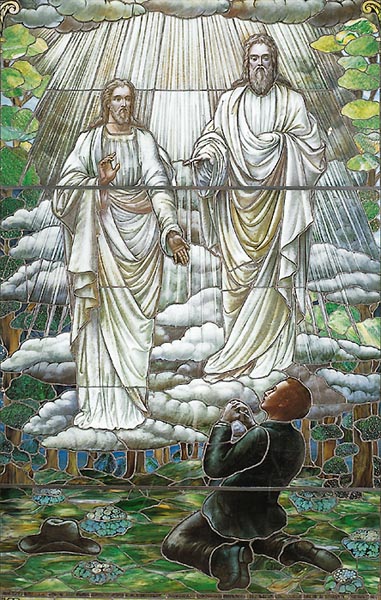
I think it is only in conversations with Mormons that I have seen the importance for our salvation that Jesus Christ "is the image of the invisible God" (Colossians 1:15). Because it is not unconnected that Joseph Smith said he saw the Father alongside the Son in a vision in 1820, and also denied that Christ's death and resurrection alone is sufficient for our salvation, or that the revelation of God in the Bible (which is all about Jesus!) alone is sufficient for us to know the Father fully.

It also makes me even more concerned than I was that Rublev's famous icon is not a wonderful celebration of the (Eastern) Orthodox understanding of the Trinity, but is actually an aberration which undermines our relationship with the true Trinity.... just to be a little controversial.

Wednesday, September 29, 2010

Testing claims to revelation

How can we know that the Bible is a true revelation of God?

1. It is consistent with what we already know to be true

"If a prophet or a dreamer of dreams arises among you and gives you a sign or a wonder, and the sign or wonder that he tells you comes to pass, and if he says, 'Let us go after other gods,' which you have not known, 'and let us serve them,' you shall not listen to the words of that prophet or that dreamer of dreams." (Deuteronomy 13:1-3)

For the non-Christian they should come to see that the message of the Bible makes sense of what they already know, and integrates with the knowledge we have already gained about science, history, morality etc. That is not to say that it should not transform how we understand what we already know, and question whether we really knew something to be true in the first place, but we are not inviting people to enter a dream world.

If like me you have recently been challenged by Mormons asking why the Book of Mormon could not also be revelation from God, then at least one thing you would want to ask is: does the Book of Mormon agree with the beating heart of the Bible which we already know to be true? In it's denial of Christ alone, I had to say the answer was 'no'.

2. What it warns and promises does happen

"if you say in your heart, ‘How may we know the word that the Lord has not spoken?’— when a prophet speaks in the name of the Lord, if the word does not come to pass or come true, that is a word that the Lord has not spoken" (Deuteronomy 18:21-22)

In line with this type of evidence standard Christian apologetic would point to OT prophecies fulfilled in Christ, but not go much further. However, I would say this is one the most important evidences there is.

When Jesus says that people will know the truth of the Gospel by the lives disciples lived, when Paul tells the Galatians that they know they have heard the truth because they received the Holy Spirit, and when 1 John says to his readers that they know they received the truth from him if they love their brothers, the evidence is this one. The Gospel promises to bring salvation, and that salvation breaks into our life in healings and other miracles, but most of all in the new life of supernatural loving service for one another and love for God.

So actually the transformed lives of people (whether drug-addicted convicts, middle-class doctors or persecutors of the church) is testimony to the truth of the Gospel. It is objective and we can raise it with confidence, although to some people resurrection life will actually look like death rather than life, but if so then they are not then rejecting the evidence but the promise (2 Corinthians 2:15-16).

Monday, September 27, 2010

Christ the one mediator

Here's the beginning of a thought:

If we accept that as the Word of God there is no knowledge of the Father apart from the Son, does that necessarily mean that there is no knowledge of the Father apart from the history of the incarnate Son?

Fact 1: Christ is the only mediator

Fact 2: Christ is the only mediator in a number of ways:

  1. Christ mediates God to us (in his divinity)
  2. Mediates us to God (in his humanity)
  3. Mediates God to us in his mediation of us to God (in his hypostatic union)

I'm no expert, but do Barthians criticise those who ignore fact 1, but make the mistake of equating point (a) with point (c) in fact 2?

In particular, can we:

  • See God revealed in and through Christ in his divinity as our creator and as judge?
  • and in distinction, God revealed in Christ in his hypostatic union as our forgiving Father?

Basically, I'm trying to think if you can preserve there being two kinds of knowledge of God (bringing death and life) while believing there is only one person through whom we can know God.

Sunday, September 26, 2010

On special request

Pretty pictures without a concluding theological reflection.

For other readers, I apologise for the lack of blogging. I am really busy, other than when I'm going for lovely walks up the Thames from Oxford.... honest.

It may be a little while before I return to proper blogging.

Saturday, September 18, 2010

Distinctives of Irenaeus

The theology of Irenaeus has two distinctive characteristics:

first, the whole of his theology is marked by his contrast between God and the Devil, and the ceaselessly raging conflict between the two powers, a conflict which is fought out in the midst of our humanity; and

second, this humanity, independently of the conflict we have mentioned, is continually in process of change, developing and altering its form, but never remaining in the same fixed pattern.

(paragraph breaks mine, p.104, Gustaf Wingren, Man and the Incarnation: A study in the Biblical Theology of Irenaeus)

Friday, September 03, 2010

Riffing on the Creed

The creed is structured by the Trinity (Father, Son and Holy Spirit), and by the three acts of God (Creation, justification and sanctification). Luther summarises it:

in all three articles God himself has revealed and opened to us the most profound depths of his fatherly heart and his pure, unutterable love.

For this very purpose he

  1. created us,
  2. so that he might redeem us
  3. and make us holy,

and, moreover,

  1. having granted and bestowed upon us everything in heaven and on earth,
  2. he has also given us his Son
  3. and his Holy Spirit

      through whom he brings us to himself.

            For, as explained above, we could never come to recognize the Father's favor and grace were it not for the LORD Christ, who is a mirror of the Father's heart. Apart from him we see nothing but an angry and terrible judge. But neither could we know anything of Christ, had it not been revealed by the Holy Spirit.

(my formatting, pp.439-440, Martin Luther, "The Large Catechism" in The Book of Concord)

The Creed says Luther, tells us what God does in us as creator, redeemer and sanctifier. He creates us, justifies us and sanctifies us. He also gives to us the rest of creation, and himself in Jesus Christ and the Holy Spirit (all of which are distinct from us - but joined to us).

see this post