
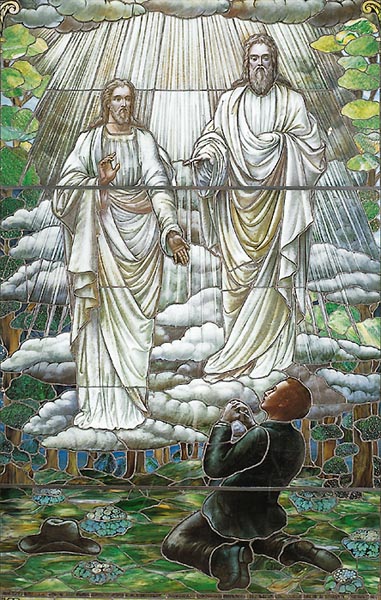
Moses endured "because he saw him who is invisible" (Hebrews 11:27). That is an incredible statement, but the seeming contradiction is just an echo of what it says in Exodus itself. We are told "the Lord used to speak to Moses face to face, as a man speaks to his friend" (33:11), despite God saying later in the same chapter that "you cannot see my face, for man shall not see me and live" (33:20)!
John confirms the witness of Old and New Testaments that "no one has ever seen God" (John 1:18), but helps clarify things later by naming the God "no one has ever seen" as the Father (6:46). Later in the John's Gospel Jesus explains that we can see his Father (gaining life), while still not seeing him (avoiding death) when he gives us that promise that "whoever has seen me has seen the Father" (14:9).
I think it is only in conversations with Mormons that I have seen the importance for our salvation that Jesus Christ "is the image of the invisible God" (Colossians 1:15). Because it is not unconnected that Joseph Smith said he saw the Father alongside the Son in a vision in 1820, and also denied that Christ's death and resurrection alone is sufficient for our salvation, or that the revelation of God in the Bible (which is all about Jesus!) alone is sufficient for us to know the Father fully.
It also makes me even more concerned than I was that Rublev's famous icon is not a wonderful celebration of the (Eastern) Orthodox understanding of the Trinity, but is actually an aberration which undermines our relationship with the true Trinity.... just to be a little controversial.

brilliant. and so helpful pastorally too. God is who he says he is.
ReplyDelete