Showing posts with label Mormonism. Show all posts

Thursday, September 30, 2010

The invisible Father we see

Moses endured "because he saw him who is invisible" (Hebrews 11:27). That is an incredible statement, but the seeming contradiction is just an echo of what it says in Exodus itself. We are told "the Lord used to speak to Moses face to face, as a man speaks to his friend" (33:11), despite God saying later in the same chapter that "you cannot see my face, for man shall not see me and live" (33:20)!

John confirms the witness of Old and New Testaments that "no one has ever seen God" (John 1:18), but helps clarify things later by naming the God "no one has ever seen" as the Father (6:46). Later in the John's Gospel Jesus explains that we can see his Father (gaining life), while still not seeing him (avoiding death) when he gives us that promise that "whoever has seen me has seen the Father" (14:9).

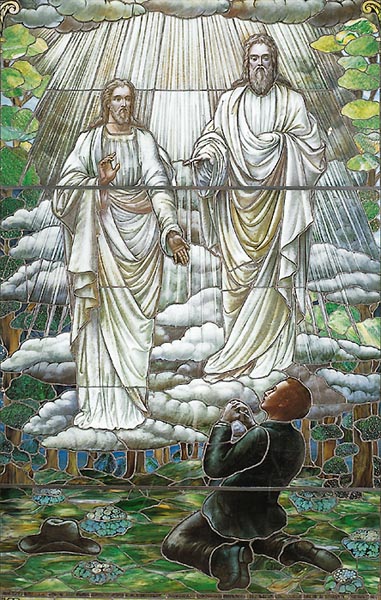
I think it is only in conversations with Mormons that I have seen the importance for our salvation that Jesus Christ "is the image of the invisible God" (Colossians 1:15). Because it is not unconnected that Joseph Smith said he saw the Father alongside the Son in a vision in 1820, and also denied that Christ's death and resurrection alone is sufficient for our salvation, or that the revelation of God in the Bible (which is all about Jesus!) alone is sufficient for us to know the Father fully.

It also makes me even more concerned than I was that Rublev's famous icon is not a wonderful celebration of the (Eastern) Orthodox understanding of the Trinity, but is actually an aberration which undermines our relationship with the true Trinity.... just to be a little controversial.

Saturday, August 21, 2010

Authority in Galatians

From my meetings with Mormons it seems that the thing that almost seems to excite them the most is the authority of the LDS Church and its Priesthoods. This is their solution to doctrinal confusion because, coupled with the warm fuzzy feeling they understand to be the witness of the Holy Spirit, they can know that a teaching is true because it comes from the LDS church.

Galatians has a different perspective on authority...

Paul recognises that the truth of the gospel he preaches depends on it coming from God.

  • He is an "apostle - not from men nor through man, but through Jesus Christ and God the Father" (1:1)
  • He says: "I did not receive it from any man, nor was I taught it, but I received it through a revelation of Jesus Christ" (1:12)
  • He spent years in the wilderness (metaphorically and literally at times) before coming to see the Apostles (2:1)
  • Who these Apostles were "makes no difference" to Paul and they added nothing to his message (2:6)

Authority is not something inherent to any person other than God, but belongs to someone so long as he preaches the Gospel.

  • His authority can be questioned if he preaches a different Gospel (1:8, and implied in 2:18)
  • Peter's authority can be questioned on the same basis (2:14)
  • Even angels should be questioned if they preach a different Gospel (1:8)

Paul's authority is paralleled in the authority of any Christian.

  • Paul was "called by [God's] grace" to preach, and had Christ revealed to him so that he could preach him to the Gentiles (1:15-16)
  • The whole Galatian church were "called [by God] in the grace of Christ" (1:6) when "Jesus Christ was publicly portrayed as crucified" to them (3:1)

The Gospel is equated by Paul with God the Father, Jesus Christ, and his crucifixion.

  • Paul equates the Gospel with God the Father (1:6; 3:6)
  • Jesus Christ (1:12; 1:16; 2:16; 5:2)
  • Jesus' death (3:1; 6:14)
  • Blessing of the Gentiles in Abraham/Christ (3:8; cf. 5:6)
  • NB the revelation of Jesus Christ, the crucified and risen One, included within it the calling of Paul to the Gentiles and knowing God as Father. These are not separate revelations or callings

The truth of the Gospel he preaches is shown in the effect it has - i.e. that it delivers the goods.

  • By hearing it the Galatians received the Holy Spirit (3:2)
  • The Spirit cries "Abba! Father!" (4:6)
  • The Spirit (presumably) is what supplies a feeling of blessing that means a great desire to serve and give gifts to the person who shared it with you whatever the cost (4:15)
  • The Spirit has fruit of "love, joy peace, patience, kindness, goodness, faithfulness, gentleness, self-control" (although note this is a imperative (walk by the Spirit), that comes from the indicative (we live by the Spirit, 5:25)
  • After all, if the Gospel is Jesus Christ then if it is being preached the Holy Spirit, who indwells the Son, will be with it.

God gives the Gospel, which is himself, to Christians who have authority in their re-presenting of the Gospel. The Gospel is both their possession and their master, just as God is given to us and yet we serve him. As soon as the Gospel is something we control we lose the possession of it, and so as soon as the preaching authority of the church is exercised outside of obedience to God we lose the authority.

To be joined to Christ by faith in him is to share his authority. To preach Christ is to exercise that authority. True authority never belongs to us or is exercised by us except dependent on Christ's personal authority. Not just in an initial gift, but continually. Christ must be the alpha and omega of our authority to teach.

I think Mormons believe Christ is the alpha, but not the omega, of the authority of their church.

Friday, August 20, 2010

Talking the Gospel with Mormons

Continuing from here, to try and write something to my Mormon visitors.

The phrase “the Gospel of Jesus Christ” is something we have used a lot, but I think we mean different things about it. And that could be seen if we ask what the word “of” means in the phrase. Correct me if I’m wrong, but I think you mean primarily that it is the Gospel that Jesus taught, about which Jesus Christ himself is a part. Christians would say that the Gospel is by Jesus and 100% about Jesus. He is both the author and the content of the Gospel.

The shortest summary of the Gospel I have heard is one word: “Jesus”. Not in the first instance Jesus’ teachings, but who he is, and if you were to summarise what the Gospel of Mark is about “Jesus” is what you’d say before you said “the teachings of Jesus”. Paul seemed to see “Jesus is Lord” as a summary of the Gospel (Rom 10:19) and John seems to think the same of “Jesus Christ has come in the flesh” (1 John 4:2). In 1 Corinthians 15 Paul tells us the Gospel is found in the central event of Jesus’ death and resurrection. The reason that the Gospel can be both the person of Jesus, but also his work of salvation in dying for our sins, and rising for our justification, is because the latter is how we know the former. We ask someone to “show us what you’re made of”, and by that we mean that we see who someone is by how they act.

We know who Jesus Christ is, and so through him who the Father is, because he showed himself as almighty and pure love in conquering the power of death by dying for those who hated him. This is “good news” (the translation of “gospel”) because it is an event that has an effect on our life. It is not advice for us to follow, or a mixture of advice and news, but news of what has been “finished” as Jesus drew his last breath for us.

The Gospel is also what Christ taught, but he talked more than anything about himself. Similarly the Bible taken as a whole is all about him from Genesis to Revelation (John 5:39; Luke 24:27). The Bible and Jesus’ own teaching does contain laws but they are fulfilled and brought to an end in Christ. They have a purpose but their purpose is preparatory to the coming of Jesus Christ into the world and our lives (Rom 5:18-21; Gal 2:21-29). Like arrows they point to Christ, but Christ is what we should look at, not the laws.

Talking Trinity with Mormons

Listening to: Beethoven: late String Quartets & LAU: Lightweights and Gentlemen

I've been having a few visits from our neighbourhood Latter-day Saints.

I wanted to wanted to write a few things to them before their next visit on some key things that have come up in our discussions. As usual I fear my ability to communicate appropriately is pretty poor, but this is what I've written as a first draft on the Trinity. Something further is coming on the Gospel. Feedback welcome.

The Trinity

Christians have always confessed that God the Father, Son and Holy Spirit are three persons, so that the Father is not the Son, and the Son is not the Father, and neither are the Holy Spirit. As you pointed out, how else could the Father speak from heaven at Jesus’ baptism, or Jesus speak to his Father in prayer?

While not negating this distinction between the persons Christians have also confessed a radical unity in the Godhead. You affirm that the Godhead is united in purpose, and in this you recognise that it would be nonsense to say that they are one in exactly the same way that they are three (i.e. that there are three persons and also one person). And unity in purpose is essential, because if there is disagreement between the Father and the Son, what hope do we have for eternity? Besides there must be some kind of oneness to do justice to all those passages where the unity between the Father and the Son in the Spirit is affirmed (e.g. John 5:19; John 14:7-11; Heb 1:3; Col 1:15-19) or those passages, esp in the Old Testament where it is is confidently declared that there is just one God (Deut 6:4; 1 Cor 8:4-6; 1 Tim 2:5). But is that enough?

1) Can we really know what God is like, for sure?

John 1:18 says that no one has ever seen God (the Father). Although you explained that Joseph Smith and others have seen God the Father in the flesh, I simply cannot understand how you can fit that with John 1:18, Col 1:15 which says God is “invisible”, and 1 Timothy 6:16 where Paul describes God as “the light which no man can approach unto; whom no man hath seen, nor can see” (cf. Ex 33:20; 1 John 4:20). However, the Son knows the Father in a way no other person does, but he makes him known to us (Matt 11:27; John 1:18)! The Christians in the first few centuries argued against saying that there was a time when the Son was not in existence, partly because then how could the Son know the Father perfectly to exactly reveal who he was. I know my housemates well, but there is a whole period of our lives when we didn’t know each other - which is one reason I can never fully know them. The Son was with the Father from the beginning of time (John 1:2) so there is no backstory that Son isn’t aware of. While to us the Father is invisible, he is fully known by the Son and by so fully revealed to us in Jesus Christ. He is both fully hidden, but also fully revealed.

2) Can we know that God is loves us forever?

If God the Father’s purposes align with the Son’s now, that is great, but what if they change? If the Spirit is sent by the Son from the Father, what happens if one day he refuses to go? I think the clue into answering these questions is the name “the Father”. At heart, if I understand you correctly, God is “the Father” for LDS because he created all of us. Therefore, there was a time when he was not “the Father”. But in that case his Fatherhood is not essential to his being. In contrast the Bible says that because the Son has always been with him, he has always been a Father of his one Son and, importantly, he always will be. If we ceased to exist then God the Father would still remain, but if the Son ceased to exist then so would the Father because who he is is tied into the Son being the Son, by whom they are united in love by the Holy Spirit.

Before any of the rest of creation the three persons of the Trinity were united in love by the Holy Spirit, in perfect relationship. Because of this the foundation of the universe is solid because it is one being, but it is also dynamic, loving and outward looking because it is three persons. This eternal relationship is the relationship Christians believe they have been invited into!

The 16th century Heidelberg Catechism asked Christian children “Why is [Jesus] called God’s ‘only Son’ when we also are God’s children?” and that question opens up some significant differences between Christian and LDS teaching. Christians believe that Jesus Christ is unique in being eternally by very nature God’s Son. In contrast, we haven’t always been children of God, but we are given the power/right to become God’s children by adoption (John 1:12; Rom 8; Gal 4:; Eph 1:5). Paul says we are adopted “through Jesus Christ” because we are co-heirs with Christ sharing his inheritance which is the Holy Spirit (Rom 8:17). This relationship of God as our Father who we can call on with confidence is secure forever, because the Father’s very being is his relationship to his Son, and Jesus Christ by identifying with us in our sin and curse has drawn us into that relationship, calling us brothers! Can you say that your relationship with God as loving heavenly Father is as secure as his very being? You can if you trust Jesus Christ is not ashamed to call us brothers, even if he has every right to be.

3) How do we receive the Holy Spirit?

The Bible calls the Holy Spirit “the Spirit of God” and “the Spirit of Christ” because they the Father, Son and Holy Spirit are inseparable. Everything the Father and Son do they do “by the Spirit”, a Spirit they share with one another. Therefore we should not expect the Spirit to come by anything other than Jesus Christ. Paul asks the Galatians “Received ye the Spirit by the works of the law, or by the hearing of faith?” answering that they received the Spirit by hearing of Jesus Christ with faith. He says the same in Ephesians 1:13 where he says that they received the Holy Spirit after hearing and then believing in Jesus Christ.

Therefore if we receive Christ, and are united to him by faith then because he and the Spirit are one then the Spirit also lives in us enabling us to imitate Jesus Christ’s life and share his sufferings and resurrection. You have explained to me that you believe that the Holy Spirit comes by priestly authority given to certain people. But the Bible says that he comes from the one high priest Jesus Christ, who is present with us whenever he is preached, and he pours the Spirit out on us as we hear about him and believe. We can be confident then that if we sincerely confess “Jesus is Lord” that we have the Spirit, because Jesus can’t be separated from his Spirit (1 Cor 12:3).