Sunday, October 22, 2006

Pragmatic Paul, or the Theologian of Tarsus?

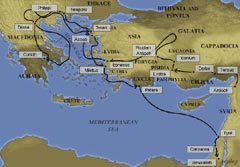
I have just had a thought going through my head for the last few days. How many times have you heard the observation on Paul's missionary journeys that he focused on cities because it would ensure the greatest impact? I.e. that by focusing on the cultural and economic centres of his day he would ensure that many people would hear the gospel and it would then spread out to the country from the bridgeheads he had developed. Tim Keller has put this best I think when he says that 'cities are where the culture is heading' and so we ought to focus our evangelism there, following the example of Paul. Essentially the consensus is that Paul was primarily a pragmatist in his choice of cities to visit.

However, I have a tentative theory to suggest. I'm sure it is not original but surprisingly I have never heard it put forward. I think Paul may have chosen to focus on cities, and particularly the cities that he did, because they were where Diaspora Jews lived. Then as now immigrant communities lived in the cities, and Paul was committed to the doctrine of 'the Jew first and also the Greek' (e.g. Rom 1:16). His evangelism was always (I can't think of an exception) begun in the synagogue of the city and he only left there either on invitation of 'God-fearing' Gentiles or after being forcefully expelled.

I have not yet met a Christian that seems to truly believe in the doctrine so central to the early church of 'to the Jew first', and I am no different. I suspect we are not half as theological as Paul was in our thoughts on all of life, including evangelism, and without knowing it we all read in our pragmatic disposition into the bible.

Saturday, October 14, 2006

Lost for words...

I would love to blog all that I am getting out of this book, but unlike the Apostle John will probably give up when faced with a challenge. It is definitely in the top couple of books I've read this year (although that is not saying much - 2006 has been a bad year).

Apparently Peter Leithart toyed with calling it Through New Eyes for Dummies, after James Jordan's book. Jordan's book is already on order from Amazon, I can barely wait.

John Stott interview

I love John Stott so much, and this interview encapsulates just about everything I love about him (HT Justin Taylor). Truly a model to emulate, and a teacher to learn from.

Friday, October 13, 2006

Freedom for 3 months!

I sat my final exam for my law module for this year with the OU. No more law for 3 months!

I just don't know what to do with myself, after so many months of hard work. 'suppose I'll catch up on some reading.

Thank God they went quite well - for a change. He is so gracious considering I am so lacking in dependence.

Wednesday, October 11, 2006

Quotable: The active and passive recipients of promise

I don't think I have read a quote which better sums up both the strength and weakness of Reformed theology so well. Following Simeon's test again - you could not find theology more exhalting to the Saviour, and humbling to the sinner; but the door for the sinner to ignore the promotion of holiness has been left ajar.

It is said, "the promise is made to the Seed," yet the promise is made to us, and yet again the covenant is made with Abraham: How can all these stand together? […] The promises that are made to us, though they be of the same covenant, nevertheless differ in this respect: the active part is committed to the Messiah, to the Seed himself, but the passive part consists of the promises made to us […] The meaning is that they are derivative promises. The primary and original promises were made to Jesus Christ.

(Preston, The New Covenant [ed. 1639], cited in p. 250, "The Doctrine of the Covenant in Reformed Theology", in Redemptive History and Biblical Interpretation: The Shorter Writings of Geerhardus Vos, ed. Richard B. Gaffin Jr.)

PS. I'd never heard of Preston but this is who he is.

Friday, October 06, 2006

Quotable: Leithart on justification

These are just a couple of quotes I wanted to note down from "'Judge Me, O God': Biblical Perspectives on Justification" by Peter Leithart. Both magnify the scale of God's saving (justifying) work, while reminding us that while it may have already been done, it is still not-yet.

It is true that God "reckons" or "considers" us righteous prior to His taking action on our behalf, and that "reckoning" is an act of sheer grace for the sake of Jesus. But that secret decision is not justification, any more than the decree to save the elect is the salvation of the elect. A judge may conclude that the accused is innocent, but his private conclusion does not constitute a legal decision. A legal decision must be promulgated as a decision of the court, and in many passages of Scripture, God’s public declaration of righteousness occurs when He "gives to the righteous according to His righteousness." God’s forensic declaration does not ring through the heavens while leaving earth in silence; rather, god’s declaration "He is righteous" affects the righteous in real time and real history. […]

Decades ago, Leon Morris wrote in his little book on The Biblical Doctrine of Judgment (1960) about the difference between modern and Hebraic conceptions of judgment. For moderns, to pass judgment means to weigh evidence and declare a sentence. Once the sentence has been passed, the judge’s job is finished, and someone other that the judge ensures that the sentence is carried out and that justice is actually done. In Scripture, however, judgment includes establishing justice as well as deciding what is just.

(pp. 212-213, Peter J. Leithart, "'Judge Me, O God': Biblical Perspectives on Justification" in The Federal Vision, ed. Steve Wilkins and Duane Garner)

The gospel really is a lot better news than bare 'forgiveness of sins'. I remember a John Piper sermon where he said: "forgiveness of sins... who cares right... I mean really?" (hopefully not too misquoted there).

In all of this, it is crucial to remember continually that justification, however defined, is by faith. And in part that means that our justification/vindication is not completely and fully revealed before the Last Judgment. We are justified in the present, but in another sense we await final public vindication. Many believers have been faithful to death, and their bones now lie in forgotten graves or scattered on the earth. God our Father, for His own infinitely wise reasons, did not intervene to rescue and justify them. But they are not forgotten, and someday they will rise to public vindication, while their enemies and accusers are silenced in darkness. Vindication may not be now; it may not be soon; but it will come. Or God is not God.

(pp. 231-232, ibid)

A sobering vision but a better hope than Rupert Brooke's which came to mind as I read it.

Quotable: Vos on the covenants

Quotes I wanted to record from the essay "The Doctrine of the Covenant in Reformed Theology" by Geerhardus Vos. I think they all pass Simeon's test too.

God does not exist because of man, but man because of God. This is what is written at the entrance of the temple of Reformed theology.

(pp. 242, "The Doctrine of the Covenant in Reformed Theology", in Redemptive History and Biblical Interpretation: The Shorter Writings of Geerhardus Vos, ed. Richard B. Gaffin Jr.)

[according to Lutheran theology] Precisely because mankind’s destination had already been reached before the fall in Adam, Christ can do nothing but restore what was lost in Adam. And since the destination already realized was fully compatible with mutability and the possibility of falling, the sinner who has been brought back to his destination by Christ must necessarily have to remain at this level. Lutheran theology is, therefore, wholly consistent when it teaches an apostasy of the saints. It does not at all object to uniting the state of justification and sonship with the possibility of such apostasy. […]

What we inherit in the second Adam is not restricted to what we lost in the first Adam: it is much rather the full realization of what the first Adam would have achieved for us had he remained unfallen and been confirmed in his state. Someone placed in that state can never again fall from it. As truly as Christ is a perfect Saviour, so truly must be bestow on us the perseverance of the saints.

(pp. 242-243, ibid)

I'd never heard these two doctrines connected before.

The obtaining of eternal life thus comes to lie in God, as a work that is Hs alone, in which His glory shines and of which nothing, without detracting from that glory, can be attributed to the creature. On this point the entire Reformation, both Lutheran and Calvinist, took exception to Rome, which failed to appreciate this fundamental truth. Yet the reasons which had driven both sides to this protest were different. With Luther it was the thirst for peace and stability for a restless conscience which could find no tranquillity in Rome’s salvation by works. As long as the sinner himself has to do something for his acquittal, his work remains unstable. Thus the sola fide became the shibboleth of the German Reformation, justification, its principle doctrine. One will agree that, despite all the purity with which this doctrine develops and in which, in developed form, it is given anew to the church, the highest point is still not reach, namely, that point from which the Scripture itself views the matter when, in the words of Paul, it sees the heart of Abraham’s faith in his “giving God the glory” (Rom 4:20). Even in its doctrine of justification Lutheranism did not catch hold of this idea in its fullness. Not a purely theological, but a partly anthropological motif ran through it. It was different with the Reformed. They, too, felt the same necessity to leave the waves of Rome’s salvation by works and once again stand on solid ground. But beside and behind this necessity there lay a deeper longing: a thirst for the glory of God that did not primarily meditate on its own peace. When the Reformed takes the obtaining of salvation completely out of man’s hands, he does this so that the glory which God gets from it might be uncurtailed. What is important for him is the realization that God glorifies Himself in the salvation of sinners, whereas the Lutheran is satisfied when it merely becomes evident that man brings nothing of his own instability into the picture. For the Reformed the center of gravity does not lie in justification as such, but in the principle by which the latter is to be judged and which the Scripture everywhere applies when it teaches us to regard the work of salvation in its totality as being exclusively a work of God.

(pp. 246-247, ibid)

According to the Lutheran, the Holy Spirit first generates faith in the sinner who temporarily still remains outside of union with Christ; then justification follows faith and only then, in turn, does the mystical union with the Mediator take place. Everything depends on this justification, which is losable, so that the believer only gets to see a little of the glory of grace and lives for the day, so to speak. The covenantal outlook is the reverse. One is first united to Christ, the Mediator of the covenant, by a mystical union, which finds its conscious recognition in faith. By this union with Christ all that is in Christ is simultaneously given. Faith embraces all this too; it not only grasps the instantaneous justification, but lays hold of Christ as Prophet, Priest and King, as his rich and full Messiah. The deepest reason for this difference in view is none other than the fact that the reception of the full glory of the work of God’s grace in the consciousness of faith is the most important thing to the Reformed believer.

(pp. 256-257, ibid)

Not sure about that last sentence though.

Carl Trueman on John Owen

I have found these lectures very thought-provoking over the last week (HT Justin Taylor):

• John Owen: The Man and His Time
• John Owen and the Practice of Theology
• John Owen on God
• John Owen on Christ
• John Owen on the Holy Spirit

It is not so much the content that has challenged me, but the passionate and enthralling picture of a way of doing theology that is quite alien to me, and that I have largely rejected.

Owen, in concert with most of the church throughout history, was very willing to be creative in his theology. Also in common with the historic church, he particularly enjoyed contemplating the nature of the Godhead. I have seen the danger of both these trajectories, but perhaps need to listen to the church more and contemplate their great helpfulness too. I will have to do some thinking on this.

Highly recommended anyway. Thank you Carl Trueman.

If Christ is a bridegroom...

Luther finds lots of wonderful implications from that metaphor.

…if Christ is a bridegroom, he must take upon himself the things which are his bride’s and bestow upon her the things that are his. If he gives her his body and very self, how shall he not give her all that is his? And if he takes the body of the bride, how shall he not take all that is hers?…

Christ is God and man in one person. He has neither sinned nor died and is not condemned and he cannot sin, die, or be condemned; his righteousness, life, and salvation are unconquerable, eternal omnipotent. By the wedding ring of faith he shares in the sins, death and pains of hell which are his bride’s…

Who then can fully appreciate what this royal marriage means? Who can understand the riches of the glory of this grace? Here this rich and divine bridegroom Christ marries this poor, wicked harlot, redeems her from all her evil, and adorns her with all his goodness. Her sins cannot now destroy her, since they are laid upon Christ and swallowed up by him. And she has that righteousness in Christ, her husband of which she may boast as of her own and which she can confidently display alongside her sins in the face of death and hell.

(from "the Freedom of a Christian," in Three Treatises, cited in p. 207 Leithart, Peter J., "'Judge Me, O God': Biblical Perspectives on Justification", in The Federal vision)

And amazingly there is plenty more in that metaphor if you think about it.

Saturday, September 30, 2006

A test

According to John Stott, Charles Simeon emphasized three things which he printed in capital letters in the preface to his works:

The Author...would wish his work to be brought to this test - Does it uniformly tend
    TO HUMBLE THE SINNER?
    TO EXALT THE SAVIOR?
    TO PROMOTE HOLINESS?
If in any one instance it loses sight of any of these points, let it be condemned without mercy. (source)

Tuesday, September 19, 2006

In their midst but still separate

When Israel camp on their way to the promised land, the tent of meeting is pitched in the centre of the camp with the tribes camped round the outside. The Levites then camp according to their clans in different groups surrounding the tent, and so protecting the rest of the people.

'The people of Israel shall pitch their tents by their companies, each man in his own camp and each man by his own standard. But the Levites shall camp around the tabernacle of the testimony, so that there may be no wrath on the congregation of the people of Israel. And the Levites shall keep guard over the tabernacle of the testimony.' (1:52f)

Further Aaron and his sons 'protect the people of Israel' by 'guarding the sanctuary itself' (3:38). The holiness of God was a fearsome thing. The tent of meeting was a sign of God's closeness to his people, but the rituals surrounding it showed that he was still separate from them. Three levels of priesthood (at least) are clear: the sons of Aaron; the Levites; the people as a whole. The OT teaches the terrible truth that not one of these levels is uncorrupted and ultimately successful in their priestly role (the sons of Aaron, Nadab and Abihu, demonstrate that just in chapter 3).

As NT Christians we know neither humanity's sin, nor God's awesome holiness, has changed (although we often forget). But Christ has demolished the curtains, and the separation between God and man, and brought God into the midst not just of a camp but of our hearts. He has done this not by compromising on God's holiness but by being the perfect priest, and the perfect priestly nation. He did everything Israel and the Levitical priesthood could not.

For it was indeed fitting that we should have such a high priest, holy, innocent, unstained, separated from sinners, and exalted above the heavens. He has no need, like those high priests, to offer sacrifices daily, first for his own sins and then for those of the people, since he did this once for all when he offered up himself. For the law appoints men in their weakness as high priests, but the word of the oath, which came later than the law, appoints a Son who has been made perfect forever.' (Heb 7:23ff)

Finally, this high priest makes us to be the new priestly nation (1 Pet 2:9), not just by cleansing us either, but by making us perfect as he is perfect (Consider a search for the word perfect in Hebrews).

So, will we, by the power of God, fulfil our calling to intercede for the world?

Crazy stuff our faith, no wonder it is foolishness to the world.

PS If you are feeling scholarly try David Peterson's Hebrews and Perfection. Not that I have, although I know where I can borrow a copy

Sunday, September 17, 2006

Giving

The sermon at Church today was on the parable of the shrewd manager. By God's grace I had a couple of thoughts.

  • Firstly, I really need to give more, and not just of my money. I am particularly weak, and particularly evil in my giving of time and my 'rights' to fairness. To win friends in this world (v.9) you have to give of your time and hold your rights loosely. Practically, I need to pick up the phone more often, email more, and more generally need to invest in relationships... and not just with those who are my friends already.
  • Secondly, I just realised that when Jesus talks about giving, he almost always talks about giving to other people, and particularly the poor. Rarely does he talk about giving to the religious institutions. This is interesting when most sermons on ‘giving’ I have attended have focused on giving to that particular church (there are all sorts of caveats here but I am trying to be brief).

Lord, show me more of how you have model self-giving to me, and by your Holy Spirit my I live in a similar way.

PT Forsyth on the Bible

I have just started Positive Preaching and the Modern Mind by PT Forsyth. He certainly is an interesting fellow, and a different writer to what I expected. As promised in the forward as well he is very quotable. Here are some things that have stood out from what I have read so far:

positive preaching

But the preacher who tries to follow this advice will find himself in one great difficulty. The Bible may be his text book, but it has ceased to be the text book of his audience. The Bible is not read by the Christian, or even by the churchgoing public, as a means of grace greater even than churchgoing. Our people, as a rule, do not read the Bible, in any sense which makes its language more familiar and dear to them than the language of the novel or the press. And I will go so far as to confess that one of the chief miscalculations I have made in the course of my own ministerial career has been to speak to congregations as if they did know and use the Bible. I was bred where it was well known and loved, and I have spent my ministerial life where it is less so. And it has taken me so long to realize the fact that I still find it difficult to adjust myself to it. I am long accustomed to being called obscure by many whose mental habits and interests are only literary, who have felt but a languid interest in the final questions of the soul as the New Testament stirs them, who treat sin as but lapse, God’s grace as if it were but love, and His love as if it were but paternal kindness. At first I believed I was obscure, and I took pains to be short in the sentence and unadorned in style. But I found my critics still puzzled. And I have come to think the obscurity is at least in some degree due to the fact that while I am attracted by such matters beyond all else, I am often dealing with people to whom they are not only strange but irritating. They have applied to religion what William Morris applied to life, "Love is enough." They have given a Christian varnish to what in him was mainly pagan, but they have not really stepped out of his natural world. They have risen to locate the affections in God; but they have not realized faith as the inroad, the uprise in us of a totally new world, Christianity as a new creation, and the new life as a new birth. Grace for them is only love exercised on the divine scale, not in the divine style, not under the conditions of holiness and sin. They read in the heart more than in the Bible. (p.21)

The Reformation was not a reformation of theology, but of faith. It is remarkable how little of the theology it changed in its first stage. It was the renewed action, not of truth, but of grace. It was the greatest of evangelical revivals. That is why it re-discovered the Bible. It was not the Bible that lighted up grace for Luther, but grace to his needy soul lighted up the Bible. Biblical preaching preaches the Gospel and uses the Bible, it does not preach the Bible and use the Gospel. (p.23)

PS If you can't buy the book, it's all online with many of his other works linked to here (on the right sidebar). But if you are like me you may find his prophetic, rhetorical style frustrating as well as enlivening

Hand picked audio resources

earphones

And all free...

Time to charge up your mp3 player.

Friday, September 08, 2006

Richard Gaffin Jr on the Reformation and the teaches the eschatological "not yet"

Richard Gaffin Jr says:

BY FAITH, NOT BY SIGHT

The reformation tradition has clearly grasped, as Paul teaches the eschatological “not yet” of our sanctification, penultimately at death and climactically at Christ’s return, and that our being perfectly conformed to the image of Christ is, until his return and the resurrection of the body, still future. It has maintained that truth more or less consistently, even though at times some have been drawn away, for example, toward various cheap perfectionisms and easy “victorious life” positions.

But, we may ask, has the Reformation grasped as clearly the “resurrection,” eschatological “already” of our sanctification? For instance, as we consider preaching and teaching in our traditions, how many Christians understand that the Holy Spirit presently at work in them is nothing less than resurrection power, that the Spirit, through whom God “will give life to your mortal bodies,” is “his Spirit who dwells in you” (Rom 8:11)? How many believers grasp that the Holy Spirit indwelling them is an eschatological power, that, in terms of the metaphors Paul uses, he in his activity in the church is an actual “down payment” on our eschatological inheritance (2 Cor 1:22, 5:5; Eph 1:14), the “firstfruits” of the full “harvest” of his eschatological working (Rom 8:23)? How many appreciate that Christ himself, as “life-giving Spirit” (1 Cor 15:45), is present and at work in our lives in his resurrection power?

[…]

In the matter of sanctification, it seems to me, we must confront a tendency, at least practical and, my impression is, pervasive, within churches of the Reformation to view the gospel and salvation in its outcome almost exclusively in terms of justification. Recall, for instance, the statement of our conference speaker quoted in the previous chapter, to the effect that the gospel is only about what Christ has done “for us” and apparently does not include his work, through the Spirit, “in us”.

The effect of this outlook, whether or not intended, is that sanctification tends to be seen as the response of the believer to salvation, defined in terms of justification. Sanctification is viewed as an expression of gratitude from our side for our justification and the free forgiveness of our sins, usually with the accent on the imperfection and inadequacy of such expressions of gratitude. Sometimes there is even the suggestion that while sanctification is highly desirable, and its lack certainly unbecoming and inappropriate, it is not really necessary in the life of the believer, not really integral to our salvation and an essential part of what it means to be saved from sin. The attitude we may have – at least this is the way it comes across – is something like, “If Jesus did that for you, died that your sins might be forgiven, shouldn’t you at least do this for him, try to please him?”

With such a construction justification and sanctification are pulled apart; the former is what God does, the latter what we do, and do so inadequately. At worst, this outlook tends to devolve into a deadening moralism.

(pp. 75-76, By Faith, Not by Sight: Paul and the Order of Salvation, Carlisle:Paternoster)

Wednesday, September 06, 2006

Moving the centre of faith

Both Mark Horne and Mark Lauterbach have posted some encouraging God-centred posts coming from different angles.

Sunday, September 03, 2006

Richard Gaffin Jr on Paul’s emphasis on the passivity of Jesus in his resurrection

Richard Gaffin Jr says:

BY FAITH, NOT BY SIGHT

God in his specific identity as the Father raises Jesus; correlatively, Jesus is passive in his resurrection. This viewpoint is maintained consistently by Paul, without exception, as far as I can see. Nowhere does he say that Christ was active in his resurrection, much less that he raised himself. Paul does not teach that Christ “rose” from the dead, but that he “was raised.”

[…]

The theological significance of this stress plainly lies in what we have seen is the controlling unity there is between the resurrection of Christ and the resurrection of believers. Christ’s passivity in his resurrection reflects his identification and solidarity with believers in being raised from the dead. For Paul, not in conflict with but other than the way it is often understood, the resurrection is not the especially evident display and powerful proof of Christ’s, divinity, but rather the vindication of the incarnate [my italics] Christ in his suffering and obedience unto death,, and, with that, the powerful transformation of him in his humanity.

[…]

Some comment should be made her on the relationship of Paul’s invariable emphasis on the passivity of Jesus in his resurrection to Jesus’ own statements elsewhere suggesting or affirming that he actively rose from the dead [a footnote lists the examples of Jon 2:19 and 10:17-18] […] Paul looks at the resurrection in terms of the Adamic identity of Jesus and the genuine humanity he shares with believers, while Jesus in John’s Gospel affirms what is also true, because of the deity he shares with the Father in his unique identity and relationship as the Son.

(pp. 65-67, By Faith, Not by Sight: Paul and the Order of Salvation, Carlisle:Paternoster)

Recent Leithart

Two great (and brief) posts in a row:

All followed up by a post I just don't understand

Typical Peter Leithart.

------- UPDATE -------

I have been prompted to think a great deal about God's judgment recently, and Leithart's follow-up post to the one mentioned above on imprecatory prayers gives more detailed application and is very helpful, as is the post of Jim he points to.

I am convinced this is a thinking on these things is no mere accademic activity but gives glory to our Father. It cuts deep but we must never move away from God's hatred of sin (cf. also Adrian Warnock's post).

YHWH and David, God and his anointed

I found these passages quite difficult, and the observations and thoughts in this post are even more incomplete, tentative, and provisional than usual. However, I noticed that these two chapters have at least two things in common.

1. The recognising of YHWH’s anointed

David recognises Saul as anointed by God and refuses to kill him when encouraged to by his men. He does this despite the risk this involves with his life by letting the man hunting him to escape. He does this despite the personal reward that beckons, as the man anointed to be king next.

Saul, in an unusual moment of clarity, recognises David as anointed by God to be king next. This must not have come easy as it involves confessing that his son will not be, and his legacy will be lost.

Nabal lives up to his name and foolishly can only see David for what he is at the moment, a servant of himself seemingly claiming a title and honours he doesn’t deserve.

God’s anointed one, his chosen one, is not always recognised by everyone. It was true of David, it was true of Jesus, and it is true of the Church. The author of Samuel may consider that Nabal was a very foolish man, but his actions are very understandable. Although the world may always be looking for ‘a sign’ God does not always provide one (though sometimes he does) and further holds us accountable when we do not recognise the truth with or without one. Countless times I have been told this is unfair of God, but God responds that the truth is clear if our heart is not hardened.

2. Leaving YHWH to do the dirty work

David refuses to kill Saul because, as Saul is anointed by God, to do so would be to rebel against YHWH. But this does not mean that he does not think Saul should be killed. After the incident he exclaims to Saul

May the Lord judge between me and you, may the Lord avenge me against you, but my hand shall not be against you. As the proverb of the ancients says, ‘Out of the wicked comes wickedness.’ But my hand shall not be against you. After whom has the king of Israel come out? After whom do you pursue? After a dead dog! After a flea! May the Lord therefore be judge and give sentence between me and you, and see to it and plead my cause and deliver me from your hand.” (vv. 12-15)

It is for God and God alone to bring about his purposes if it involves the death of another. For chapter 25 shows that it is not just his anointed that David is unwilling to murder.

Nabal in insulting David is also insulting God, and David is riled by Nabal’s arrogance. However he is restrained by a wise Abigail who reminds him that God will achieve his own purposes, and in this way David will be prevented from bloodguilt. Sure enough, ten days later Nabal is dead.

YHWH has again opened up himself to the charge that he is unrighteous, and unreasonable. How can God cause the death of Nabal, and later Saul, and yet not be tainted by the bloodguilt that David would have incurred?

I don’t have a complete answer to this question.

The bible makes it clear that both Saul and Nabal received just recompense for evil they had committed. It is also clear that there is no fairer judge that YHWH, and no one else with the right to take that place for themselves.

The focus of this passage is not on these apologetic questions – important as they are – but on God himself. It is concerned with God’s power and his purposes, and recognising these and acting on them.

Pray the world recognises Jesus Christ (trans ‘anointed one’) for who he is, and look toward his coming for the completion of his purposes of judgment and blessing.

Saturday, September 02, 2006

Richard Gaffin Jr on what is true and what should be

Richard Gaffin Jr says:

BY FAITH, NOT BY SIGHT

[…]“seek after what you already have, because you already have it.”

In the study of Paul in the modern period this pattern of teaching has been the object of a fair amount of discussion and is often referred to as the “the problem of indictive and imperative in Paul”. While this teaching certain [sic] challenges the church, it is not ultimately problematic and so might better be referred to as the pattern or phenomenon of indicative and imperative in Paul. In addition to Colossians 3:1-4, the following passages belong to this pattern:

Galatians 5:25: “If we live in the Spirit, let us walk in the Spirit,” virtually equivalent to, “If we live in the Spirit let us live in the Spirit.”

Galatians 5:1: “Christ has set us free for freedom, stand firm and don’t be burdened again with a yoke of slavery.” Equivalent in its elemental thrust to, “you are free, therefore be free.”

Ephesians 5:8: “But now you are light in the Lord; walk as children of light.”

1 Corinthians 5:7: “Get rid of the old leaven that you may become a new batch of dough [= “become unleavened”], even as you become unleavened.”

Galatians 3:27: the indicative, believers “have put off the old man and put on the new”; Ephesians 4:22-24, on the most likely reading: the imperative, they are to “put off the old and put on the new.”

Romans 6:2: the indicative, “you have died to sin”, verse 12 the imperative, “do not let sin reign in your mortal body.”

[…]

Paul, we may observe, never writes in the imperative without first writing , at least implicitly, in the indicative. That is so because he knows all too well, better than some subsequent preachers, that “it does no good to beat a dead horse” – which is exactly what the congregation is apart from Christ, apart from who they are and what they have in him.

(pp. 69-72, By Faith, Not by Sight: Paul and the Order of Salvation, Carlisle:Paternoster)

Tuesday, August 22, 2006

A thought of the summer

I am going to try and get this blog going over the coming week.

I a going to start with a an interesting thought that I read somewhere over the summer:

People contrast human- and God-centred religion often. But a true understanding of humanity, the image of God, should point to God. There is nothing wrong with being human-centred in our religion because it does not exclude being God-centred. Both God and humanity should be at the centre of our lives, but not some false vision of either. They are not rivals for our affection. This point is beautifully summed up by Jesus:

You shall love the Lord your God with all your heart and with all your soul and with all your mind. This is the great and first commandment. And a second is like it: You shall love your neighbor as yourself. On these two commandments depend all the Law and the Prophets.” (Matt 22)

Among other things I think this leads to a correct view of 'social justice', and a God-exhalting view of creation.

Friday, July 14, 2006

A tentpeg through his head - pure, lovely, and commendable?

Quite some time ago Mark Heath wrote a worship song with the following words:

Come hear the story of Deborah
And the defeat of Sisera
She prophesied, "take an army, and fight against Canaan"
The people gladly followed under Barak's command
And God gave the battle into their hands

There they fell, dead
God's enemies defeated
Killed by the armies of Yahweh
But their leader ran away


Blessed be Jael the Kenite
Who offered milk and a bed for the night
She took a tent peg in her left hand, and a hammer in her right
And when he started snoring, she approached him from behind
And crushed his skull with all of her might

There he fell, dead
With a tent peg through his head
Killed by a friend of the family
As he slept in her bed


Poor old Sisera's mummy
Wonders where her little boy has gone
"Now don't you worry, he'll be home soon"
"He's probably raping a girl or two"
"And when he's done with them he'll steal some clothes for you"

There he lay, dead
With a tent peg through his head
Killed by a friend of the family
As he slept in her bed

When I first heard it (and blogged about it) I was very unsure about it. I have listened to it a lot since then, and thought about it some more. I am convinced that we must begin to worship God for his judgment of evil people. When Habakkuk complains to God about injustice against the poor of Israel, God's response is to assure Habakkuk they the perpetrators of injustice will be punished and Habakkuk welcomes that. And Jesus did not do anything different, as Mary the mother of Jesus sings with joy to God:

He has shown strength with his arm;
he has scattered the proud in the thoughts of their hearts;
he has brought down the mighty from their thrones
and exalted those of humble estate;
he has filled the hungry with good things,
and the rich he has sent empty away.

I have to challenge myself to ask why I have trouble singing with Mary on this. I suspect it is because I am not the poor but the rich, and am aware enough of my sin to dislike the idea of coming judgment. Yet Jesus held out hope even to the rich in letting himself be judged and I must rejoice but with a humble heart.

A good Job by Calvin

Although I am not a big Puritan fan, and don't really get on with Jonathan Edwards, I do so love John Calvin. Here is a great quote from him on Job (HT Mark Horne):

Let us have such modesty in us, as not to attempt anything against him: but whensoever it shall please him to chastise us, let every [one] of us thing thus himself: Go to, my God chastises me for such sin, and after such a manner: and it behooves me to make my profit of it. Therefore let us not be deaf when God warns us after that fashion: according to the examples he gives us, to the intent we grow not past grace, and so the thing befall us which is spoken heretofore, namely that we heap up continuously a greater wrath and a more horrible vengeance of God upon us.

(Calvin, Sermons on Job, Sermon 141, 36:15-19, p., 665)

I often think that Job is much less concerned about the 'problem of suffering' and much more about a wider understanding of how we follow God. I think we narrow it's application when we only think about it as that. Like all the bible it is about the greatness of God, the sinfulness and creatureliness of humanity, and the grace of a God who reaches down.

Actually, when I came to read the passage he is commenting on it is (perhaps unsurprisingly) even more brilliant than Calvin's comment, and this is because it is so concerned with these big themes:

“The godless in heart cherish anger;
they do not cry for help when he binds them.
They die in youth,
and their life ends among the cult prostitutes.
He delivers the afflicted by their affliction
and opens their ear by adversity.
He also allured you out of distress
into a broad place where there was no cramping,
and what was set on your table was full of fatness.

“But you are full of the judgment on the wicked;
judgment and justice seize you.
Beware lest wrath entice you into scoffing,
and let not the greatness of the ransom turn you aside.
Will your cry for help avail to keep you from distress,
or all the force of your strength?
Do not long for the night,
when peoples vanish in their place.
Take care; do not turn to iniquity,
for this you have chosen rather than affliction.
Behold, God is exalted in his power;
who is a teacher like him?
Who has prescribed for him his way,
or who can say, ‘You have done wrong’?

“Remember to extol his work,
of which men have sung.
All mankind has looked on it;
man beholds it from afar.

Wednesday, May 17, 2006

What do you see?

The oracle of Balaam the son of Beor, the oracle of the man whose eye is opened, the oracle of him who hears the words of God, who sees the vision of the Almighty, falling down with his eyes uncovered... (Numbers 24:3-4)

Balaam in Numbers 24 does not look for omens but faces the wilderness and sees Israel camped in it (v1). Looking at homeless Israel the Spirit comes upon him and he sees much more. He sees God's blessing upon them in the form of both a vision of pastoral harmony and great power over its enemies.

Balaam in his second prophecy of the chapter, which is prefaced with the same comment as the first about seeing, prophesises that the enemies of God will ruled by 'one from Jacob [that] shall exercise dominion' (v19). Whoever this person is though it is still 'God [who] does this' (v23).

This vision of Israel on the in victorious war against its enemies is not one to bring hope to the other nations of the world and yet Psalm 66 encourages them to 'Shout for joy to God' (v1). Psalm 67 is even stronger in its encouragement to 'the nations [to] be glad and sing for joy' (v4), although the Psalmist has not forgotten that 'all the ends of the earth fear him' too (v7).

In both the two psalms only one reason is given why the nations should be glad and that is because God 'judge[s] the peoples with equity and guide[s] the nations upon earth' (67:4). Though God loves his people he is never unfair, and more than that is guiding the nations in his plan to fulfil Abraham's promise to bless the nations through Israel.

God's jealousy for his people is clearly a blessing for them, which cannot be overcome by the rival gods or people groups a Balaam and Balak found. The psalmist encourages the nations to 'Come and see what God has done' (66:5) and recounts God's unique saving acts for Israel. The implication seems to be that if you see what God has done for his people, and praise him for it, you can share in his blessing to them. As I think about the great acts of God towards his people in the past when reading Numbers, I find joy because I know instinctively that God's blessing to Israel, finding its fulfilment in Jesus' resurrection is mine too if I share in his death.

Sunday, May 07, 2006

How this blog was born

This blog was created...

  • On the suggestion of Paul's words in Philippians 4:8-9: 'Finally, brothers, whatever is true, whatever is honourable, whatever is just, whatever is pure, whatever is lovely, whatever is commendable, if there is any excellence, if there is anything worthy of praise, think about these things. What you have learned and received and heard and seen in me—practice these things, and the God of peace will be with you.'
  • On the recollection of Don Carson's words: 'People do not drift toward holiness. Apart from grace-driven effort, people do not gravitate toward godliness, prayer, obedience to Scripture, faith, and delight in the Lord.'
  • On the example of Dave Bish, Mark Lauterbach among others.
  • Using the resource of the daily Bible reading calendar created by Robert Murray M'Cheyne. and which has benefited countless Christians since.
  • And finally, on the experience of writing a blog for many months, which though I was occasionally proud of too often, though with its foundation on the gospel, did not have the gospel as its focus. I hope with this blog to think and write about the important things, not those things which my itching fingers want to write.

'rejoice in God through our Lord Jesus Christ, through whom we have now received reconciliation'