Thursday, September 30, 2010

Go there, but don't stay there

"It’s okay not to be okay — but it's not okay to stay there" (Matt Chandler, HT Justin Taylor)

Isn't that great?!

Our lives are characterised by suffering and sin. The cross overshadows all of us and it is more than "okay", it is good for us to see ourselves in the place of the cross and not deny that we are under the curse of death.

But, it is not okay to stay there because if we are on a journey with Jesus we have hope of three days later rising from the dead to a new life of praise and thankfulness in the presence of God.

In some churches it is not okay to be miserable and to mourn, either for suffering ("earth is not our home") or our sin ("everyone sins, you're not that bad"). In other churches there is no joy over the good things in creation ("earth is not our home") or the good things of redemption ("displays of emotion are not necessary in worship"). It is good for a church to be marked by both in a constant re-telling of the Gospel story of death to life. And the movement from one to another is important because that shows that life with God is our goal, and suffering is only the way we walk to get there. We repent of our sin so we can have faith in Christ, and we mourn at loss so we can rejoice consistent with that when what we lost is restored to us.

Most spiritual issues that I see people struggle with are a result of not "moving on" in this Gospel-story way. They are trapped in self-hatred, introspection and sorrow over the life they have been dealt. Most spiritual issues that I see people not struggle with is an avoidance of the narrow way of the cross. They think they're okay and probably would get on fine without God's help, because they haven't committed any terribly bad sins and they've got their health and wealth. I think I fall into both categories of person.

The invisible Father we see

Moses endured "because he saw him who is invisible" (Hebrews 11:27). That is an incredible statement, but the seeming contradiction is just an echo of what it says in Exodus itself. We are told "the Lord used to speak to Moses face to face, as a man speaks to his friend" (33:11), despite God saying later in the same chapter that "you cannot see my face, for man shall not see me and live" (33:20)!

John confirms the witness of Old and New Testaments that "no one has ever seen God" (John 1:18), but helps clarify things later by naming the God "no one has ever seen" as the Father (6:46). Later in the John's Gospel Jesus explains that we can see his Father (gaining life), while still not seeing him (avoiding death) when he gives us that promise that "whoever has seen me has seen the Father" (14:9).

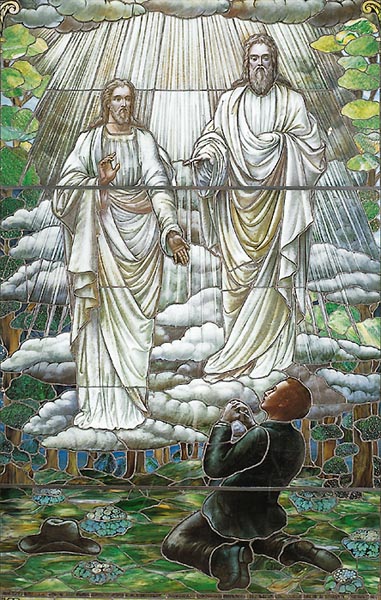
I think it is only in conversations with Mormons that I have seen the importance for our salvation that Jesus Christ "is the image of the invisible God" (Colossians 1:15). Because it is not unconnected that Joseph Smith said he saw the Father alongside the Son in a vision in 1820, and also denied that Christ's death and resurrection alone is sufficient for our salvation, or that the revelation of God in the Bible (which is all about Jesus!) alone is sufficient for us to know the Father fully.

It also makes me even more concerned than I was that Rublev's famous icon is not a wonderful celebration of the (Eastern) Orthodox understanding of the Trinity, but is actually an aberration which undermines our relationship with the true Trinity.... just to be a little controversial.

Wednesday, September 29, 2010

Testing claims to revelation

How can we know that the Bible is a true revelation of God?

1. It is consistent with what we already know to be true

"If a prophet or a dreamer of dreams arises among you and gives you a sign or a wonder, and the sign or wonder that he tells you comes to pass, and if he says, 'Let us go after other gods,' which you have not known, 'and let us serve them,' you shall not listen to the words of that prophet or that dreamer of dreams." (Deuteronomy 13:1-3)

For the non-Christian they should come to see that the message of the Bible makes sense of what they already know, and integrates with the knowledge we have already gained about science, history, morality etc. That is not to say that it should not transform how we understand what we already know, and question whether we really knew something to be true in the first place, but we are not inviting people to enter a dream world.

If like me you have recently been challenged by Mormons asking why the Book of Mormon could not also be revelation from God, then at least one thing you would want to ask is: does the Book of Mormon agree with the beating heart of the Bible which we already know to be true? In it's denial of Christ alone, I had to say the answer was 'no'.

2. What it warns and promises does happen

"if you say in your heart, ‘How may we know the word that the Lord has not spoken?’— when a prophet speaks in the name of the Lord, if the word does not come to pass or come true, that is a word that the Lord has not spoken" (Deuteronomy 18:21-22)

In line with this type of evidence standard Christian apologetic would point to OT prophecies fulfilled in Christ, but not go much further. However, I would say this is one the most important evidences there is.

When Jesus says that people will know the truth of the Gospel by the lives disciples lived, when Paul tells the Galatians that they know they have heard the truth because they received the Holy Spirit, and when 1 John says to his readers that they know they received the truth from him if they love their brothers, the evidence is this one. The Gospel promises to bring salvation, and that salvation breaks into our life in healings and other miracles, but most of all in the new life of supernatural loving service for one another and love for God.

So actually the transformed lives of people (whether drug-addicted convicts, middle-class doctors or persecutors of the church) is testimony to the truth of the Gospel. It is objective and we can raise it with confidence, although to some people resurrection life will actually look like death rather than life, but if so then they are not then rejecting the evidence but the promise (2 Corinthians 2:15-16).

Monday, September 27, 2010

Christ the one mediator

Here's the beginning of a thought:

If we accept that as the Word of God there is no knowledge of the Father apart from the Son, does that necessarily mean that there is no knowledge of the Father apart from the history of the incarnate Son?

Fact 1: Christ is the only mediator

Fact 2: Christ is the only mediator in a number of ways:

  1. Christ mediates God to us (in his divinity)
  2. Mediates us to God (in his humanity)
  3. Mediates God to us in his mediation of us to God (in his hypostatic union)

I'm no expert, but do Barthians criticise those who ignore fact 1, but make the mistake of equating point (a) with point (c) in fact 2?

In particular, can we:

  • See God revealed in and through Christ in his divinity as our creator and as judge?
  • and in distinction, God revealed in Christ in his hypostatic union as our forgiving Father?

Basically, I'm trying to think if you can preserve there being two kinds of knowledge of God (bringing death and life) while believing there is only one person through whom we can know God.

Sunday, September 26, 2010

On special request

Pretty pictures without a concluding theological reflection.

For other readers, I apologise for the lack of blogging. I am really busy, other than when I'm going for lovely walks up the Thames from Oxford.... honest.

It may be a little while before I return to proper blogging.

Saturday, September 18, 2010

Distinctives of Irenaeus

The theology of Irenaeus has two distinctive characteristics:

first, the whole of his theology is marked by his contrast between God and the Devil, and the ceaselessly raging conflict between the two powers, a conflict which is fought out in the midst of our humanity; and

second, this humanity, independently of the conflict we have mentioned, is continually in process of change, developing and altering its form, but never remaining in the same fixed pattern.

(paragraph breaks mine, p.104, Gustaf Wingren, Man and the Incarnation: A study in the Biblical Theology of Irenaeus)

Friday, September 03, 2010

Riffing on the Creed

The creed is structured by the Trinity (Father, Son and Holy Spirit), and by the three acts of God (Creation, justification and sanctification). Luther summarises it:

in all three articles God himself has revealed and opened to us the most profound depths of his fatherly heart and his pure, unutterable love.

For this very purpose he

  1. created us,
  2. so that he might redeem us
  3. and make us holy,

and, moreover,

  1. having granted and bestowed upon us everything in heaven and on earth,
  2. he has also given us his Son
  3. and his Holy Spirit

      through whom he brings us to himself.

            For, as explained above, we could never come to recognize the Father's favor and grace were it not for the LORD Christ, who is a mirror of the Father's heart. Apart from him we see nothing but an angry and terrible judge. But neither could we know anything of Christ, had it not been revealed by the Holy Spirit.

(my formatting, pp.439-440, Martin Luther, "The Large Catechism" in The Book of Concord)

The Creed says Luther, tells us what God does in us as creator, redeemer and sanctifier. He creates us, justifies us and sanctifies us. He also gives to us the rest of creation, and himself in Jesus Christ and the Holy Spirit (all of which are distinct from us - but joined to us).

see this post

Friday, August 27, 2010

Three Cs of training

The nature and goal of training can be very usefully summarized by three Cs. Through personal relationship, prayer, teaching, modelling and practical instruction, we want to see people grow in:

  • conviction - their knowledge of God and understanding of the Bible
  • character - the godly charactter and life that accords with sound doctrine
  • competency - the ability to prayerfully speak God's word to others in a variety of ways.

(p. 78, Colin Marshall and Tony Payne, The Trellis and the Vine)

I like that a lot.

The Trellis and the Vine is a good book. Not quite deserving of the fame it is getting in the States, but with a simple but powerful message nevertheless. Basically, it is a call to 121 (and small, not home, group) ministry from the top down. The reason being that salvation by speaking the word, not maintenance of structures and programs, is the goal of the church.

Mark Dever's endorsement catches it well:

Four great links

All four move both your heart and mind.

Theologians are people for whom the Christian faith is especially difficult, incomprehensible, infuriating. As a rule they are not especially talented or spiritually adept individuals. They are people whose minds have been hurt by God, and they are restlessly searching (read more)

Gregory (Against Eunomius, 3.3) insists that only a Trinitarian theology can truly affirm the goodness of God. He assumes the Scriptural titles for the Son – light, truth, life, glory – and asks whether the Father could ever have been without these goods. If He was once without the Son, then He was once without these goods. God is good because God is Triune (read more)

What would you write to your suffering, struggling, almost compromising friend?

If you were the Apostle John writing under the inspiration of the Holy Spirit, you would write to him about God (read more)

By Faith from Keith and Kristyn Getty on Vimeo.

Wednesday, August 25, 2010

A call to the real world of worship

In his lectures on "Biblical Spirituality" Eugene Peterson remembers that he received the biggest postbag of angry letters when he wrote an article criticising Myers-Briggs profiling. This surprised him as he didn't realise how it was so precious to people.

He probably got a bigger postbag after he endorsed The Shack though. I tried to find the Myers-Briggs article on the internet and failed. I did find this paragraph though:

Every call to worship is a call into the Real World. You’d think that by this time in my life I wouldn't need to be called anymore. But I do. I encounter such constant and widespread lying about reality each day and meet with such skilled and systematic distortion of the truth that I’m always in danger of losing my grip on reality. The reality, of course, is that God is sovereign and Christ is savior. The reality is that prayer is my mother tongue and the eucharist my basic food. The reality is that baptism, not Myers-Briggs, defines who I am.

(p. 28, Take and read: spiritual reading: an annotated list)

Tuesday, August 24, 2010

Four potential pitfalls in workplace evangelism

Four potential pitfalls in workplace evangelism:

  1. Not making time
    • To be with people
    • To pray for people
  2. Trying to do it in your own strength
  3. Facts without love
  4. A lifestyle that detracts from the message

From: Dom Hughes, Evangelism for Lawyers, MP3.

Saturday, August 21, 2010

Fractures healed

In Eden man is a social being living harmoniously in all his relations:

  • With God;
  • With woman (i.e. the rest of humanity as it was!);
  • With the environment; and
  • With himself.

[Incidentally, I think we often forget that final one. He felt no shame, didn't wish to be someone else; someone taller, cleverer, fitter, etc.]

With the Fall "the bond of fellowship between God and man is broken by rebellion and sin', and because it "belongs to the nature of sin to divide", and because when God's rule is rejected Sin rules instead, that crack spreads to all man's other relationships.

Man cannot heal the rupture by starting with self-healing because it is the bond between man and God which "really makes man man". Jesus Christ gave us unity in ourselves by restoring the bond between God and man in an "eternal union between God and man in himself". That inner unity and harmony in Jesus Christ, and not us with ourselves without reference to God, spreads, binding up all the ruptured relationships in the world as his Kingdom increases.

(Quotations from pp. 38-50, TF Torrance, The Incarnation)

Fulfilled from both sides

[In the Old Covenant, God] wills to be a father to his people, and desires his people to be his children. 'I will be your Father, and you will be my children. I am holy, therefore be you holy. Walk before me and be perfect.' [cf. Lev 26:12; 2 Sam 7:14; Lev 11:44; Gen 17:1]

[In sending his Son] God fulfils the covenant from the side of God, 'I will be your God, your Father', and fulfils the covenant from the side of man, 'I will be your obedient child'. This is the mighty act of the incarnation which is at once the act of God's humiliation and the act of man's exaltation, for he who in such amazing grace descended to make our lost cause his own, ascended in accomplishment of his task, elevating man into union and communion with the life of God.

(pp. 56-57, TF Torrance, The Incarnation)

Order, foundation and support

Irenaeus in his Demonstration of the Apostolic Preaching:

This then is

  • the order of our faith,
  • the foundation of our building
  • and the support of our conduct:

  God the Father,

  • uncreated, uncontainable, invisible;
  • one God, the creator of all things:
this is the first point of our faith.

The second point is this:
  the Word of God, Son of God, Christ Jesus our Lord,

  • who appeared to the prophets, each characteristically and according to the Father's way of disposing;
  • through Christ all things were made,
  • and he also at the end of the times, to complete and gather up all things, was made man among men, visible and tangible, in order to abolish death and show forth life and effect communion between god and man.

And the third point is:
  the Holy Spirit

  • through who the prophets prophesied, the patriarchs learned the things of God, and the righteous were led into the way of righteousness;
  • and who in the end of times was poured out in a new way upon the human race, renewing man in all the earth unto God.

(my formatting, cited in Geoffrey Wainwright, "Trinity" in, ed Vanhoozer, Dictionary for Theological Interpretation of the Bible)

Great stuff. That dictionary is a funny thing, but it's full of gems.

The fact of assurance

Well did James Denney once observe that whereas assurance is a sin in Romanism, and a duty in much of Protestantism, in the New Testament it is simply a fact.

(JI Packer, Knowing God)

Authority in Galatians

From my meetings with Mormons it seems that the thing that almost seems to excite them the most is the authority of the LDS Church and its Priesthoods. This is their solution to doctrinal confusion because, coupled with the warm fuzzy feeling they understand to be the witness of the Holy Spirit, they can know that a teaching is true because it comes from the LDS church.

Galatians has a different perspective on authority...

Paul recognises that the truth of the gospel he preaches depends on it coming from God.

  • He is an "apostle - not from men nor through man, but through Jesus Christ and God the Father" (1:1)
  • He says: "I did not receive it from any man, nor was I taught it, but I received it through a revelation of Jesus Christ" (1:12)
  • He spent years in the wilderness (metaphorically and literally at times) before coming to see the Apostles (2:1)
  • Who these Apostles were "makes no difference" to Paul and they added nothing to his message (2:6)

Authority is not something inherent to any person other than God, but belongs to someone so long as he preaches the Gospel.

  • His authority can be questioned if he preaches a different Gospel (1:8, and implied in 2:18)
  • Peter's authority can be questioned on the same basis (2:14)
  • Even angels should be questioned if they preach a different Gospel (1:8)

Paul's authority is paralleled in the authority of any Christian.

  • Paul was "called by [God's] grace" to preach, and had Christ revealed to him so that he could preach him to the Gentiles (1:15-16)
  • The whole Galatian church were "called [by God] in the grace of Christ" (1:6) when "Jesus Christ was publicly portrayed as crucified" to them (3:1)

The Gospel is equated by Paul with God the Father, Jesus Christ, and his crucifixion.

  • Paul equates the Gospel with God the Father (1:6; 3:6)
  • Jesus Christ (1:12; 1:16; 2:16; 5:2)
  • Jesus' death (3:1; 6:14)
  • Blessing of the Gentiles in Abraham/Christ (3:8; cf. 5:6)
  • NB the revelation of Jesus Christ, the crucified and risen One, included within it the calling of Paul to the Gentiles and knowing God as Father. These are not separate revelations or callings

The truth of the Gospel he preaches is shown in the effect it has - i.e. that it delivers the goods.

  • By hearing it the Galatians received the Holy Spirit (3:2)
  • The Spirit cries "Abba! Father!" (4:6)
  • The Spirit (presumably) is what supplies a feeling of blessing that means a great desire to serve and give gifts to the person who shared it with you whatever the cost (4:15)
  • The Spirit has fruit of "love, joy peace, patience, kindness, goodness, faithfulness, gentleness, self-control" (although note this is a imperative (walk by the Spirit), that comes from the indicative (we live by the Spirit, 5:25)
  • After all, if the Gospel is Jesus Christ then if it is being preached the Holy Spirit, who indwells the Son, will be with it.

God gives the Gospel, which is himself, to Christians who have authority in their re-presenting of the Gospel. The Gospel is both their possession and their master, just as God is given to us and yet we serve him. As soon as the Gospel is something we control we lose the possession of it, and so as soon as the preaching authority of the church is exercised outside of obedience to God we lose the authority.

To be joined to Christ by faith in him is to share his authority. To preach Christ is to exercise that authority. True authority never belongs to us or is exercised by us except dependent on Christ's personal authority. Not just in an initial gift, but continually. Christ must be the alpha and omega of our authority to teach.

I think Mormons believe Christ is the alpha, but not the omega, of the authority of their church.

Under the sun

Qoheleth could have used the phrase "under the heavens" to describe life on earth full of breath/vanity. I think he used the phrase he did because:

  1. The word "under" has connotations of rule in the OT, and perhaps even harsh rule (cf. Paul's use of "under the law")
  2. For Israelites the "sun" was not the happy smiley face in the skies that English people think of. The favourite weather forecast for Israelites was rain because sun meant baking heat. It was "oppressive" weather when the sun ruled the skies.

Trinitarian structures?

Eugene Peterson structures his course on "Biblical Spirituality" like the following boxes. He admits that there is a lot of bleed between them (e.g. that all three persons of the Trinity are involved in creation, justification and sanctification; and that creation, justification and sanctification are all of a piece, as is Christ's atoning work).

Given those caveats, is there enough distinction to use this as a structure? The early church in the creeds certainly agreed about the first two columns tying together in some way.

God the FatherCreationChrist's birth
God the SonRedemptionChrist's death
God the Holy SpiritHoly LivingChrist's resurrection

Incidentally, I think, having just heard Tim Chester on Eschatology, I might add a fourth column:

God the FatherCreationChrist's birthFirst Creation
God the SonRedemptionChrist's deathDeath of Fallen Creation
God the Holy SpiritHoly LivingChrist's resurrectionNew Creation

...I don't know there are things I like and dislike.

Friday, August 20, 2010

Talking the Gospel with Mormons

Continuing from here, to try and write something to my Mormon visitors.

The phrase “the Gospel of Jesus Christ” is something we have used a lot, but I think we mean different things about it. And that could be seen if we ask what the word “of” means in the phrase. Correct me if I’m wrong, but I think you mean primarily that it is the Gospel that Jesus taught, about which Jesus Christ himself is a part. Christians would say that the Gospel is by Jesus and 100% about Jesus. He is both the author and the content of the Gospel.

The shortest summary of the Gospel I have heard is one word: “Jesus”. Not in the first instance Jesus’ teachings, but who he is, and if you were to summarise what the Gospel of Mark is about “Jesus” is what you’d say before you said “the teachings of Jesus”. Paul seemed to see “Jesus is Lord” as a summary of the Gospel (Rom 10:19) and John seems to think the same of “Jesus Christ has come in the flesh” (1 John 4:2). In 1 Corinthians 15 Paul tells us the Gospel is found in the central event of Jesus’ death and resurrection. The reason that the Gospel can be both the person of Jesus, but also his work of salvation in dying for our sins, and rising for our justification, is because the latter is how we know the former. We ask someone to “show us what you’re made of”, and by that we mean that we see who someone is by how they act.

We know who Jesus Christ is, and so through him who the Father is, because he showed himself as almighty and pure love in conquering the power of death by dying for those who hated him. This is “good news” (the translation of “gospel”) because it is an event that has an effect on our life. It is not advice for us to follow, or a mixture of advice and news, but news of what has been “finished” as Jesus drew his last breath for us.

The Gospel is also what Christ taught, but he talked more than anything about himself. Similarly the Bible taken as a whole is all about him from Genesis to Revelation (John 5:39; Luke 24:27). The Bible and Jesus’ own teaching does contain laws but they are fulfilled and brought to an end in Christ. They have a purpose but their purpose is preparatory to the coming of Jesus Christ into the world and our lives (Rom 5:18-21; Gal 2:21-29). Like arrows they point to Christ, but Christ is what we should look at, not the laws.

Talking Trinity with Mormons

Listening to: Beethoven: late String Quartets & LAU: Lightweights and Gentlemen

I've been having a few visits from our neighbourhood Latter-day Saints.

I wanted to wanted to write a few things to them before their next visit on some key things that have come up in our discussions. As usual I fear my ability to communicate appropriately is pretty poor, but this is what I've written as a first draft on the Trinity. Something further is coming on the Gospel. Feedback welcome.

The Trinity

Christians have always confessed that God the Father, Son and Holy Spirit are three persons, so that the Father is not the Son, and the Son is not the Father, and neither are the Holy Spirit. As you pointed out, how else could the Father speak from heaven at Jesus’ baptism, or Jesus speak to his Father in prayer?

While not negating this distinction between the persons Christians have also confessed a radical unity in the Godhead. You affirm that the Godhead is united in purpose, and in this you recognise that it would be nonsense to say that they are one in exactly the same way that they are three (i.e. that there are three persons and also one person). And unity in purpose is essential, because if there is disagreement between the Father and the Son, what hope do we have for eternity? Besides there must be some kind of oneness to do justice to all those passages where the unity between the Father and the Son in the Spirit is affirmed (e.g. John 5:19; John 14:7-11; Heb 1:3; Col 1:15-19) or those passages, esp in the Old Testament where it is is confidently declared that there is just one God (Deut 6:4; 1 Cor 8:4-6; 1 Tim 2:5). But is that enough?

1) Can we really know what God is like, for sure?

John 1:18 says that no one has ever seen God (the Father). Although you explained that Joseph Smith and others have seen God the Father in the flesh, I simply cannot understand how you can fit that with John 1:18, Col 1:15 which says God is “invisible”, and 1 Timothy 6:16 where Paul describes God as “the light which no man can approach unto; whom no man hath seen, nor can see” (cf. Ex 33:20; 1 John 4:20). However, the Son knows the Father in a way no other person does, but he makes him known to us (Matt 11:27; John 1:18)! The Christians in the first few centuries argued against saying that there was a time when the Son was not in existence, partly because then how could the Son know the Father perfectly to exactly reveal who he was. I know my housemates well, but there is a whole period of our lives when we didn’t know each other - which is one reason I can never fully know them. The Son was with the Father from the beginning of time (John 1:2) so there is no backstory that Son isn’t aware of. While to us the Father is invisible, he is fully known by the Son and by so fully revealed to us in Jesus Christ. He is both fully hidden, but also fully revealed.

2) Can we know that God is loves us forever?

If God the Father’s purposes align with the Son’s now, that is great, but what if they change? If the Spirit is sent by the Son from the Father, what happens if one day he refuses to go? I think the clue into answering these questions is the name “the Father”. At heart, if I understand you correctly, God is “the Father” for LDS because he created all of us. Therefore, there was a time when he was not “the Father”. But in that case his Fatherhood is not essential to his being. In contrast the Bible says that because the Son has always been with him, he has always been a Father of his one Son and, importantly, he always will be. If we ceased to exist then God the Father would still remain, but if the Son ceased to exist then so would the Father because who he is is tied into the Son being the Son, by whom they are united in love by the Holy Spirit.

Before any of the rest of creation the three persons of the Trinity were united in love by the Holy Spirit, in perfect relationship. Because of this the foundation of the universe is solid because it is one being, but it is also dynamic, loving and outward looking because it is three persons. This eternal relationship is the relationship Christians believe they have been invited into!

The 16th century Heidelberg Catechism asked Christian children “Why is [Jesus] called God’s ‘only Son’ when we also are God’s children?” and that question opens up some significant differences between Christian and LDS teaching. Christians believe that Jesus Christ is unique in being eternally by very nature God’s Son. In contrast, we haven’t always been children of God, but we are given the power/right to become God’s children by adoption (John 1:12; Rom 8; Gal 4:; Eph 1:5). Paul says we are adopted “through Jesus Christ” because we are co-heirs with Christ sharing his inheritance which is the Holy Spirit (Rom 8:17). This relationship of God as our Father who we can call on with confidence is secure forever, because the Father’s very being is his relationship to his Son, and Jesus Christ by identifying with us in our sin and curse has drawn us into that relationship, calling us brothers! Can you say that your relationship with God as loving heavenly Father is as secure as his very being? You can if you trust Jesus Christ is not ashamed to call us brothers, even if he has every right to be.

3) How do we receive the Holy Spirit?

The Bible calls the Holy Spirit “the Spirit of God” and “the Spirit of Christ” because they the Father, Son and Holy Spirit are inseparable. Everything the Father and Son do they do “by the Spirit”, a Spirit they share with one another. Therefore we should not expect the Spirit to come by anything other than Jesus Christ. Paul asks the Galatians “Received ye the Spirit by the works of the law, or by the hearing of faith?” answering that they received the Spirit by hearing of Jesus Christ with faith. He says the same in Ephesians 1:13 where he says that they received the Holy Spirit after hearing and then believing in Jesus Christ.

Therefore if we receive Christ, and are united to him by faith then because he and the Spirit are one then the Spirit also lives in us enabling us to imitate Jesus Christ’s life and share his sufferings and resurrection. You have explained to me that you believe that the Holy Spirit comes by priestly authority given to certain people. But the Bible says that he comes from the one high priest Jesus Christ, who is present with us whenever he is preached, and he pours the Spirit out on us as we hear about him and believe. We can be confident then that if we sincerely confess “Jesus is Lord” that we have the Spirit, because Jesus can’t be separated from his Spirit (1 Cor 12:3).

Wednesday, August 18, 2010

A little note on the Noahic covenant

There are three aspects to the Noahic covenant:

  1. God promises to hold back from exercising his authority. God will "never again... curse the ground because of man" however evil they are.
  2. God delegates the rights and responsibilities of his authority to humanity:
    • Man is to be fruitful, and fill the earth;
    • Man is to eat of every creature on the earth, in the sea and in the air.
    • Man is to judge any man or animal that kills another man.
  3. This is bought at a price - a price that continually needs to be paid:
    • The Noahic covenant is founded on sacrifice, because it is given in response to Noah's sacrifice on the altar he builds in 8:20.
    • The Noahic covenant requires continual sacrifices - that is the implication of the seemingly strange command not to eat the blood in animals. The reason being that "the life of the flesh is in the blood, and ... it is the blood that makes atonement" (Lev 17:11).

God didn't give up on this promise to delegate authority to humanity, even though "at present, we do not yet see everything in subjection to" man (Hebrews 2). He has already given it to "a man whom he has appointed" who "will judge the world in righteousness" (Acts 17:31) and share his power to judge with his brothers (1 Cor 6:2).

We can now eat meat with blood in it. Not for some arbitrary reason, but because the blood of Jesus was the one sacrifice for all time, God demands no more sacrifice as the price of the promise.

Jesus received the promises of delegated authority given to THE image of God, THE man (Adam). He received those promises because he paid the full price in blood. Graciously he shares the promise of delegated rule (and, to a degree, the cost) with those united to him by faith.

[Aside:

"Whoever sheds the blood of man,
by man shall his blood be shed,
for God made man in his own image." (Gen 9:6)

I have always assumed that the "image of God" in this passage refers primarily to the person who is murdered, but I think it is more likely to be the person who executes the murderer. As I've long been convinced - "image of God" is more functional than ontological.]

Thursday, August 12, 2010

Unoriginal reflection on 1 Kings 15:3-5

"[Abijah] committed all the sins his father had done before him; his heart was not fully devoted to the LORD his God, as the heart of David his forefather had been. Nevertheless, for David's sake the LORD his God gave him a lamp in Jerusalem by raining up a son to succeed him and by making Jerusalem strong. For David had done what was right in the eyes of the LORD and had not failed to keep any of the LORD's commands all the days of his life - except in the case of Uriah the Hittite." (1 Kings 15:3-5)

Abijah sinned.

God blessed him despite his sin because of the righteousness of his federal head, David.

David's righteousness was imperfect, so there was a limit to the covering provided.

One day the covering wore out, as the hole spread and split the whole garment.

The lamp was removed, no son of David reigned and Jerusalem burned.

We sinned.

God blessed us despite our sin because of the righteousness of our federal head, Jesus Christ, son of David.

David's greater son, did what was right, with no exception.

Christ's righteousness was perfect without exception, so there is no flaw in the covering provided.

If we repent of our sin, our lamp will never be removed, for Christ reigns forever and we live in a lasting city.

Tuesday, August 10, 2010

Forcing into a unity

Many arguments about theology, and particularly apologetics seems to be about where we start. For example, when talking about God do we start with the Trinity because the concept 'god' we come with is a Procrustean bed which will prevent us ever having a true understanding of God, or can we start with our flawed concepts and refine and reshape until we get to a correct understanding?

Oswald Bayer summarises the alternative we are often presented with:

Does theology start with a particular concept in order to demonstrate its universality, or does it begin with a general indeterminate concept in order to fill it with a specifically Christian content?

He says both alternatives, epitomised by Barth and Schleiermacher respectively, share in common the belief that there is a unified reality that we can know now. Bayer argues that on the contrary God encounters us now in distinct ways which cannot be overcome except in the Eschaton. He lists these as:

  1. "through the opposition of the law that points its accusing finger at me, convicts me of sin, and hands me over to death;"
  2. "through the promise of the gospel, in which God himself speaks for me, indeed take my place in Jesus Christ;"
  3. "through the assault of God's incomprehensible, crushing hiddenness that radically contradicts the gospel and is more than merely an effect of the law";

As human beings we are constantly trying to create an all-encompassing unity in God, or our theological system, but while this unity must "be believed [it cannot] also be conceived" by the mind.

If we speak of a "unity" in connection with law and gospel, life and death, judgment and grace, it must be clear that this is meant in a strictly eschatological sense"

... of course, where Barth is correct is in recognising that the Eschaton has been brought forward in the person and work of Jesus Christ - so we can look for unity in him, as well as at some indeterminate point in the future.

Simul iustus et peccator

Do Christians have a dual identity as both sinners and saints? There are several ways of thinking about this that I don't like because they're essentially static.

Paul though talks about our "old self" and "new self". There are several things to note about the way he uses this language:

  • The use of temporal language implies a movement from one to the other.
  • This implied movement also includes an implied priority of the latter over the former. We are not equally saints and sinners, but are saints more than sinners because in the Bible the end defines us more than the beginning.
  • Our "old self" is still our "self". I.e. it is still who we are, not a different person.
  • The movement from old to new has happened in Christ, happened in our new birth/baptism, happens continually in our lives now (Romans 8:13; Colossians 3:5) and will be completed in our physical death and resurrection. I think it is in an exclusive emphasis on one battle in this continuing war (in which the decisive battle has already occurred) that all problems with affirmations/denials of this doctrine emerge.

Calvin and Luther's anthropology of the Christian

Some interesting selections from Mark Seifrid's article "Rightly Dividing the Word of Truth: An Introduction to the Distinction between Law and Gospel" that relate to discussions among some blogs about whether we are simul iustus et peccator (e.g. here and here). I've collected some links to Mark Seifrid articles here.

In such passages as Gal 5:17-26, "flesh" and "Spirit" do not appear there as capacities or qualities of a unified human person, but two different descriptions of the whole person. The old, fallen human being in Adam exists along with the new creation that God has made us to be in Jesus Christ. We must hasten to add that the relationship between the two is unequal. Our sinful self, which is incapable of faith and obedience to God, has been crucified with Christ (see, e.g., Gal 5:24-26; Rom 8:7-8). Although our fallen person, "the flesh," remains present until the end of our earthly life (Rom 7:24), that fallen existence is present now only as a conquered reality. [...]

The Christian life consists in our "putting to death" our former self [i.e. us as "sinner"] by our new self [i.e. us as "saint"], present in the Spirit who dwells in us (Rom 8:12-14; Gal 5:16-17).

As is the case with Scripture and our understanding of God, so it is with us for Luther: the unity of our person lies outside of us in Jesus Christ. We grasp it now by faith, but it is only in the resurrection that it shall become visible. Calvin regards regeneration to effect a new state within the human being, which is partially present and active. The "flesh" likewise is present as a power that exerts partial influence on us. [...] Luther, as we have seen, finds a radically different anthropology in Scripture. The old, fallen creature exists as a whole alongside the new creature, who is likewise a whole.