Thursday, October 21, 2010

Four aspects of organic change

Christian change is:

  1. Gradual - so be patient
  2. Inevitable - so be optimistic, because the Spirit is omnipotent.
  3. Internal - so cultivate love in your heart, because if works don't grow from love of God and neighbour it's dangerous (1 Cor 13:1; Matt 7:21-23).
  4. Symmetrical - so be suspicious of 'self-control' with no joy, or 'love' but no faithfulness, because if what you call self-control/love etc exists without the others then it is probably counterfeit because they are interdependent (cf. 1 John 4:20).

According to Tim Keller, in his sermon on the fruit of the Spirit in Galatians 5:22-23.

A more beautiful tune

"In Greek mythology the spirits of the sea were called the Sirens. They had the bodies of birds and the heads of beautiful women. These sirens lived on stretches of rocky coast and reefs and sang a beautiful song to entice sailors to them, and so the sailors were drawn to their death. However, two famous sailors managed to sail past safely.

One was Odysseus, who filled his sailors' ears with wax so that they could not hear the beautiful song,, and had himself tied to the mast, so that although he could hear it he could not steer the ship towards them. He got past safely enough, but spent all his time wishing he could have gone closer. that, I think, is a picture of how some of us live the Christian life... purely prevention by constraint.

[Instead] we need to look to the other sailor who managed to get past the temptations of the Sirens. He was called Orpheus. and his tactic was different. He was a musician and so he played a tune himself - a more beautiful tune than the song of the Sirens, so his sailors weren't drawn to them."

(pp.73-74, Graham Beynon, Experiencing the Spirit)

Saturday, October 16, 2010

Christ who lives in the future, and the church's mission to prepare the world for the future to arrive

When he had gone out, Jesus said, “Now is the Son of Man glorified, and God is glorified in him. If God is glorified in him, God will also glorify him in himself, and glorify him at once. Little children, yet a little while I am with you. You will seek me, and just as I said to the Jews, so now I also say to you, ‘Where I am going you cannot come.’ A new commandment I give to you, that you love one another: just as I have loved you, you also are to love one another. By this all people will know that you are my disciples, if you have love for one another.”

Structurally, it is clear that Jesus' packed statement of John 13:31-35 is explicated by the disciples asking a series of questions which Jesus answers in 13:36-14:31.

Peter: “Lord, where are you going?”

Jesus: You can follow me later

Peter: “Lord, why can I not follow you now? I will lay down my life for you.”

Jesus: You won't lay down your life. I will prepare the place ON YOUR BEHALF to prepare the destination.

Thomas: “Lord, we do not know where you are going. How can we know the way?”

Jesus: I am the way to the Father.

Philip: “Lord, show us the Father, and it is enough for us.”

Jesus: The Father, and so the Kingdom/New Creation, is already present in me. I will send the Spirit to help you when I'm gone and you can no longer see the Father in me physically.

Belief -> missionary miracles

Prayer -> receiving

Loving -> obeying

I will appear again after the resurrection to those who love me though.

Judas (not Iscariot): “Lord, how is it that you will manifest yourself to us, and not to the world?”

Jesus: Because God only makes his home with those who love and obey me.

It still isn't crystal clear to me, but this is the line of logic I see going on behind Jesus' answers:

  1. I'm going to die an Old Creation death, and then live a New Creation life in the presence of the Father.
  2. You can't follow me all the way yet because you are not yet made holy, but I will go as your representative ahead of you.
  3. However, you can see the Father and the New Creation life already in me as it bursts out even in this likeness of sinful flesh.
  4. When I'm living a full New Creation life in heaven you will still be able to see me by faith given by the Holy Spirit whom I will send.
  5. As those who have been reborn and love God, I will be able to give you fuller experience of New Creation life and the presence of the Father after I have been resurrected, because you will be holy enough to be in the presence of such life.
  6. However, the world cannot experience me in my New Creation life because I will be so burning in holiness that I would be Christ-the-judge to them (in contrast to pre-cross when I am their suffering servant). Out of mercy, as I did in the Tabernacle, I will hide my holy presence for a time to give them time to repent.
  7. However, as you follow me you will repeat the same story. For now you will live a life of self-sacrifice and suffering servanthood with your glory as children of God veiled. In this role you will represent me to the world by a life of loving obedience and miracles.

That's a bit hastily written and I'd like to write that up neatly, but what do you reckon? Seems to tie together a lot of the Bible, and this passage in particular.

Categories to apply:

  • sinful/holy
  • servant/judge
  • Old Creation/New Creation
  • death/life
  • suffering/glorified

Basically, Jesus is further down the road than the church on every count and prepares the way for us. Because the world is still at the starting point, the church mediates the destination to them because if Jesus was present now there would be no time to repent.

PS I'm sorry for the note-taking form of this post. I wanted to write it up but when I'm going to be short on sleep tonight finishing off some law study I couldn't justify editing. Thought it maybe of interest though - some significant stuff.

An explosion of joy

I am concerned to explore the question how the mission of the Church is rooted in the gospel itself. There has been a long tradition which sees the mission of the Church primarily as obedience to a command. It has been customary to speak of 'the missionary mandate.' This way of putting the matter is certainly not without justification, and yet it seems to me that it misses the point... If one looks at the New Testament evidence one gets another impression.

Mission begins with a kind of explosion of joy. The news that the rejected and crucified Jesus is alive is something that cannot possibly be suppressed. It must be told. Who could be silent about such a fact? The mission of the Church in the pages of the New Testament is like the fallout from a vast explosion, a radioactive fallout which is not lethal but life-giving.

(p. 116, Lesslie Newbigin, The Gospel in a Pluralist Society)

HT Jared Wilson, who goes onto say:

I agree with John Piper that "mission exists because worship does not," but I also believe that mission exists because worship does.

Monday, October 11, 2010

Your law is my delight

(HT Tim)

"I long for your salvation, O Lord,
and your law is my delight.
Let my soul live and praise you,
and let your rules help me.
I have gone astray like a lost sheep; seek your servant,
for I do not forget your commandments."

(Psalm 119:174-176)

"I delight in the law of God, in my inner being,
but I see in my members another law waging war against the law of my mind and making me captive to the law of sin that dwells in my members. Wretched man that I am! Who will deliver me from this body of death?
Thanks be to God through Jesus Christ our Lord!"

(Romans 7:22-25)

Both passages include:

  • delight in the law; and
  • a realisation of our failure to keep it.

After this common starting point:

  • The OT passage includes a prayer to be delivered.
  • The NT passage includes thanks that we have been delivered.

Apologetics in Galatians

Paul in Galatians spends roughly the first half of Galatians explaining how his Gospel is true, and the second half how it is morally good.

So the first half of Galatians speaks to the agnosticism of our culture that thinks we cannot know the truth of God. Following Kant (?) most people I know think that it is impossible for us to know anything for certain about God. As naturalists they believe we live in a closed natural system where it is impossible for us to believe God has spoken or worked miracles. So given that it is impossible for us to know anything about God, it is permissible to believe anything about God but never permissible to be certain about it. The critique of the Bible you hear from people you meet is that it is just human opinion, and as such has no more weight than the speculation of any other human. In response to this I don’t think it is best to simply assert that we can’t avoid absolute truth in religious statements, instead it is better to FIRST admit that our culture is right that if the Bible is just human opinions then we shouldn’t say that the Gospel is absolute truth. THEN, as Paul does in the first few chapters of Galatians, demonstrate the Gospel is “not from men nor through man, but through Jesus Christ and God the Father” so we can be certain of it’s truthfulness.

The second half of Galatians speaks to the belief that religious certainty breeds hate and events like 9/11. In fact, Paul actually anticipates the concerns of postmodern pragmatic-pluralists who believe that claims to absolute truth tend to be power-plays which end up in division. He shows the judaizer’s false gospel is a form slavery, which they only preach so that the Galatians “may make much of them” and they can “boast in [the Galatians] flesh” (4:17; 6:13). Not only that, but as it is only the true Gospel that brings the Spirit and the Spirit’s fruit, any false gospel we come across will only lead to “enmity, strife, jealousy, fits of anger, rivalries, dissensions, [and] divisions” (5:20). So freedom from oppression and moral goodness are key concerns of Paul that overlap with our pluralist culture, but he would criticise pluralism as a false gospel that oppresses people and fractures society as much as any other worldview. So again, with Paul, we can FIRST agree that claims to absolute truth tend to be both oppressive and divisive. THEN as Paul does, show how the Gospel is unique in bringing freedom as well as the motivation and power to love our neighbour and bear one another’s burdens (5:14; 6:2).

Monday, October 04, 2010

"One cannot coerce the summer into corning, one must wait for it"

The relation of the human to the created world around him is characterized in the first place by the fact that the human receives. God gives, we receive: that is the melody which Luther is always playing, in constantly new variations.

[...]

We must assert that it is God, not we or our neighbor, who is at work in the workshop which nature constitutes. The one who is at work in nature without interruption is God, and he is creating. The concept of nature belongs primarily to dogmatics, not to ethics. What God's work in creation demands of us is not first action, but faith. This is declared already in the Sermon on the Mount. The lilies of the field and the birds of the air instruct us, according to Jesus, about "care-free-ness" as the only completely natural attitude in life. Be not anxious for clothing or for food! God cares for you, he knows what you need.

(Gustaf Wingren, "The Doctrine of Creation: Not an Appendix but the First Article" in Word & World 4/4, 1984)

Death and life

"the gospels all witness to the fact that the triumph of life over death is there understood to be the decisive victory, much more important than the victory of knowledge over ignorance.

[Similarly...]

Baptism and Eucharist yield resurrection, not only forgiveness for the harassed conscience. The point in what is said about the restoration of creation (recapitulatio) is that everything which God has created has a part in the salvation which God gives in Christ. The great antithesis is between death and life, not between guilt and forgiveness."

(Gustaf Wingren, "The Doctrine of Creation: Not an Appendix but the First Article" in Word & World 4/4, 1984)

The sacred beauty of creation

"There are two occasions when the sacred beauty of Creation becomes dazzlingly apparent, and they occur together. One is when we feel our mortal insufficiency to the world, and the other is when we feel the world's mortal insufficiency to us"

(p.280, Marilynne Robinson, Gilead)

Sunday, October 03, 2010

Scribes and prophets

Listening to: the ubiquitous Mumford and Sons: Sigh no More

The fictional Reverend John Ames is reading an magazine article entitled 'God and the American People':

it says 95 percent of us say we believe in God. But our religion doesn't meet the writer's standards, not at all. To his mind, all those people in all those churches are the scribes and the Pharisees. He seems to me to be a bit of a scribe himself, scorning and rebuking the way he does. How do you tell a scribe from a prophet, which is what he clearly takes himself to be? The prophets love the people they chastise, a thing this writer does not appear to me to do.

(p.162, Marilynne Robinson, Gilead)

Thursday, September 30, 2010

Go there, but don't stay there

"It’s okay not to be okay — but it's not okay to stay there" (Matt Chandler, HT Justin Taylor)

Isn't that great?!

Our lives are characterised by suffering and sin. The cross overshadows all of us and it is more than "okay", it is good for us to see ourselves in the place of the cross and not deny that we are under the curse of death.

But, it is not okay to stay there because if we are on a journey with Jesus we have hope of three days later rising from the dead to a new life of praise and thankfulness in the presence of God.

In some churches it is not okay to be miserable and to mourn, either for suffering ("earth is not our home") or our sin ("everyone sins, you're not that bad"). In other churches there is no joy over the good things in creation ("earth is not our home") or the good things of redemption ("displays of emotion are not necessary in worship"). It is good for a church to be marked by both in a constant re-telling of the Gospel story of death to life. And the movement from one to another is important because that shows that life with God is our goal, and suffering is only the way we walk to get there. We repent of our sin so we can have faith in Christ, and we mourn at loss so we can rejoice consistent with that when what we lost is restored to us.

Most spiritual issues that I see people struggle with are a result of not "moving on" in this Gospel-story way. They are trapped in self-hatred, introspection and sorrow over the life they have been dealt. Most spiritual issues that I see people not struggle with is an avoidance of the narrow way of the cross. They think they're okay and probably would get on fine without God's help, because they haven't committed any terribly bad sins and they've got their health and wealth. I think I fall into both categories of person.

The invisible Father we see

Moses endured "because he saw him who is invisible" (Hebrews 11:27). That is an incredible statement, but the seeming contradiction is just an echo of what it says in Exodus itself. We are told "the Lord used to speak to Moses face to face, as a man speaks to his friend" (33:11), despite God saying later in the same chapter that "you cannot see my face, for man shall not see me and live" (33:20)!

John confirms the witness of Old and New Testaments that "no one has ever seen God" (John 1:18), but helps clarify things later by naming the God "no one has ever seen" as the Father (6:46). Later in the John's Gospel Jesus explains that we can see his Father (gaining life), while still not seeing him (avoiding death) when he gives us that promise that "whoever has seen me has seen the Father" (14:9).

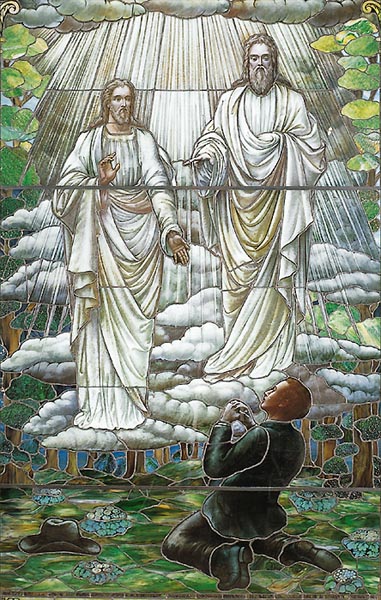
I think it is only in conversations with Mormons that I have seen the importance for our salvation that Jesus Christ "is the image of the invisible God" (Colossians 1:15). Because it is not unconnected that Joseph Smith said he saw the Father alongside the Son in a vision in 1820, and also denied that Christ's death and resurrection alone is sufficient for our salvation, or that the revelation of God in the Bible (which is all about Jesus!) alone is sufficient for us to know the Father fully.

It also makes me even more concerned than I was that Rublev's famous icon is not a wonderful celebration of the (Eastern) Orthodox understanding of the Trinity, but is actually an aberration which undermines our relationship with the true Trinity.... just to be a little controversial.

Wednesday, September 29, 2010

Testing claims to revelation

How can we know that the Bible is a true revelation of God?

1. It is consistent with what we already know to be true

"If a prophet or a dreamer of dreams arises among you and gives you a sign or a wonder, and the sign or wonder that he tells you comes to pass, and if he says, 'Let us go after other gods,' which you have not known, 'and let us serve them,' you shall not listen to the words of that prophet or that dreamer of dreams." (Deuteronomy 13:1-3)

For the non-Christian they should come to see that the message of the Bible makes sense of what they already know, and integrates with the knowledge we have already gained about science, history, morality etc. That is not to say that it should not transform how we understand what we already know, and question whether we really knew something to be true in the first place, but we are not inviting people to enter a dream world.

If like me you have recently been challenged by Mormons asking why the Book of Mormon could not also be revelation from God, then at least one thing you would want to ask is: does the Book of Mormon agree with the beating heart of the Bible which we already know to be true? In it's denial of Christ alone, I had to say the answer was 'no'.

2. What it warns and promises does happen

"if you say in your heart, ‘How may we know the word that the Lord has not spoken?’— when a prophet speaks in the name of the Lord, if the word does not come to pass or come true, that is a word that the Lord has not spoken" (Deuteronomy 18:21-22)

In line with this type of evidence standard Christian apologetic would point to OT prophecies fulfilled in Christ, but not go much further. However, I would say this is one the most important evidences there is.

When Jesus says that people will know the truth of the Gospel by the lives disciples lived, when Paul tells the Galatians that they know they have heard the truth because they received the Holy Spirit, and when 1 John says to his readers that they know they received the truth from him if they love their brothers, the evidence is this one. The Gospel promises to bring salvation, and that salvation breaks into our life in healings and other miracles, but most of all in the new life of supernatural loving service for one another and love for God.

So actually the transformed lives of people (whether drug-addicted convicts, middle-class doctors or persecutors of the church) is testimony to the truth of the Gospel. It is objective and we can raise it with confidence, although to some people resurrection life will actually look like death rather than life, but if so then they are not then rejecting the evidence but the promise (2 Corinthians 2:15-16).

Monday, September 27, 2010

Christ the one mediator

Here's the beginning of a thought:

If we accept that as the Word of God there is no knowledge of the Father apart from the Son, does that necessarily mean that there is no knowledge of the Father apart from the history of the incarnate Son?

Fact 1: Christ is the only mediator

Fact 2: Christ is the only mediator in a number of ways:

  1. Christ mediates God to us (in his divinity)
  2. Mediates us to God (in his humanity)
  3. Mediates God to us in his mediation of us to God (in his hypostatic union)

I'm no expert, but do Barthians criticise those who ignore fact 1, but make the mistake of equating point (a) with point (c) in fact 2?

In particular, can we:

  • See God revealed in and through Christ in his divinity as our creator and as judge?
  • and in distinction, God revealed in Christ in his hypostatic union as our forgiving Father?

Basically, I'm trying to think if you can preserve there being two kinds of knowledge of God (bringing death and life) while believing there is only one person through whom we can know God.

Sunday, September 26, 2010

On special request

Pretty pictures without a concluding theological reflection.

For other readers, I apologise for the lack of blogging. I am really busy, other than when I'm going for lovely walks up the Thames from Oxford.... honest.

It may be a little while before I return to proper blogging.

Saturday, September 18, 2010

Distinctives of Irenaeus

The theology of Irenaeus has two distinctive characteristics:

first, the whole of his theology is marked by his contrast between God and the Devil, and the ceaselessly raging conflict between the two powers, a conflict which is fought out in the midst of our humanity; and

second, this humanity, independently of the conflict we have mentioned, is continually in process of change, developing and altering its form, but never remaining in the same fixed pattern.

(paragraph breaks mine, p.104, Gustaf Wingren, Man and the Incarnation: A study in the Biblical Theology of Irenaeus)

Friday, September 03, 2010

Riffing on the Creed

The creed is structured by the Trinity (Father, Son and Holy Spirit), and by the three acts of God (Creation, justification and sanctification). Luther summarises it:

in all three articles God himself has revealed and opened to us the most profound depths of his fatherly heart and his pure, unutterable love.

For this very purpose he

  1. created us,
  2. so that he might redeem us
  3. and make us holy,

and, moreover,

  1. having granted and bestowed upon us everything in heaven and on earth,
  2. he has also given us his Son
  3. and his Holy Spirit

      through whom he brings us to himself.

            For, as explained above, we could never come to recognize the Father's favor and grace were it not for the LORD Christ, who is a mirror of the Father's heart. Apart from him we see nothing but an angry and terrible judge. But neither could we know anything of Christ, had it not been revealed by the Holy Spirit.

(my formatting, pp.439-440, Martin Luther, "The Large Catechism" in The Book of Concord)

The Creed says Luther, tells us what God does in us as creator, redeemer and sanctifier. He creates us, justifies us and sanctifies us. He also gives to us the rest of creation, and himself in Jesus Christ and the Holy Spirit (all of which are distinct from us - but joined to us).

see this post

Friday, August 27, 2010

Three Cs of training

The nature and goal of training can be very usefully summarized by three Cs. Through personal relationship, prayer, teaching, modelling and practical instruction, we want to see people grow in:

  • conviction - their knowledge of God and understanding of the Bible
  • character - the godly charactter and life that accords with sound doctrine
  • competency - the ability to prayerfully speak God's word to others in a variety of ways.

(p. 78, Colin Marshall and Tony Payne, The Trellis and the Vine)

I like that a lot.

The Trellis and the Vine is a good book. Not quite deserving of the fame it is getting in the States, but with a simple but powerful message nevertheless. Basically, it is a call to 121 (and small, not home, group) ministry from the top down. The reason being that salvation by speaking the word, not maintenance of structures and programs, is the goal of the church.

Mark Dever's endorsement catches it well:

Four great links

All four move both your heart and mind.

Theologians are people for whom the Christian faith is especially difficult, incomprehensible, infuriating. As a rule they are not especially talented or spiritually adept individuals. They are people whose minds have been hurt by God, and they are restlessly searching (read more)

Gregory (Against Eunomius, 3.3) insists that only a Trinitarian theology can truly affirm the goodness of God. He assumes the Scriptural titles for the Son – light, truth, life, glory – and asks whether the Father could ever have been without these goods. If He was once without the Son, then He was once without these goods. God is good because God is Triune (read more)

What would you write to your suffering, struggling, almost compromising friend?

If you were the Apostle John writing under the inspiration of the Holy Spirit, you would write to him about God (read more)

By Faith from Keith and Kristyn Getty on Vimeo.

Wednesday, August 25, 2010

A call to the real world of worship

In his lectures on "Biblical Spirituality" Eugene Peterson remembers that he received the biggest postbag of angry letters when he wrote an article criticising Myers-Briggs profiling. This surprised him as he didn't realise how it was so precious to people.

He probably got a bigger postbag after he endorsed The Shack though. I tried to find the Myers-Briggs article on the internet and failed. I did find this paragraph though:

Every call to worship is a call into the Real World. You’d think that by this time in my life I wouldn't need to be called anymore. But I do. I encounter such constant and widespread lying about reality each day and meet with such skilled and systematic distortion of the truth that I’m always in danger of losing my grip on reality. The reality, of course, is that God is sovereign and Christ is savior. The reality is that prayer is my mother tongue and the eucharist my basic food. The reality is that baptism, not Myers-Briggs, defines who I am.

(p. 28, Take and read: spiritual reading: an annotated list)

Tuesday, August 24, 2010

Four potential pitfalls in workplace evangelism

Four potential pitfalls in workplace evangelism:

  1. Not making time
    • To be with people
    • To pray for people
  2. Trying to do it in your own strength
  3. Facts without love
  4. A lifestyle that detracts from the message

From: Dom Hughes, Evangelism for Lawyers, MP3.

Saturday, August 21, 2010

Fractures healed

In Eden man is a social being living harmoniously in all his relations:

  • With God;
  • With woman (i.e. the rest of humanity as it was!);
  • With the environment; and
  • With himself.

[Incidentally, I think we often forget that final one. He felt no shame, didn't wish to be someone else; someone taller, cleverer, fitter, etc.]

With the Fall "the bond of fellowship between God and man is broken by rebellion and sin', and because it "belongs to the nature of sin to divide", and because when God's rule is rejected Sin rules instead, that crack spreads to all man's other relationships.

Man cannot heal the rupture by starting with self-healing because it is the bond between man and God which "really makes man man". Jesus Christ gave us unity in ourselves by restoring the bond between God and man in an "eternal union between God and man in himself". That inner unity and harmony in Jesus Christ, and not us with ourselves without reference to God, spreads, binding up all the ruptured relationships in the world as his Kingdom increases.

(Quotations from pp. 38-50, TF Torrance, The Incarnation)

Fulfilled from both sides

[In the Old Covenant, God] wills to be a father to his people, and desires his people to be his children. 'I will be your Father, and you will be my children. I am holy, therefore be you holy. Walk before me and be perfect.' [cf. Lev 26:12; 2 Sam 7:14; Lev 11:44; Gen 17:1]

[In sending his Son] God fulfils the covenant from the side of God, 'I will be your God, your Father', and fulfils the covenant from the side of man, 'I will be your obedient child'. This is the mighty act of the incarnation which is at once the act of God's humiliation and the act of man's exaltation, for he who in such amazing grace descended to make our lost cause his own, ascended in accomplishment of his task, elevating man into union and communion with the life of God.

(pp. 56-57, TF Torrance, The Incarnation)

Order, foundation and support

Irenaeus in his Demonstration of the Apostolic Preaching:

This then is

  • the order of our faith,
  • the foundation of our building
  • and the support of our conduct:

  God the Father,

  • uncreated, uncontainable, invisible;
  • one God, the creator of all things:
this is the first point of our faith.

The second point is this:
  the Word of God, Son of God, Christ Jesus our Lord,

  • who appeared to the prophets, each characteristically and according to the Father's way of disposing;
  • through Christ all things were made,
  • and he also at the end of the times, to complete and gather up all things, was made man among men, visible and tangible, in order to abolish death and show forth life and effect communion between god and man.

And the third point is:
  the Holy Spirit

  • through who the prophets prophesied, the patriarchs learned the things of God, and the righteous were led into the way of righteousness;
  • and who in the end of times was poured out in a new way upon the human race, renewing man in all the earth unto God.

(my formatting, cited in Geoffrey Wainwright, "Trinity" in, ed Vanhoozer, Dictionary for Theological Interpretation of the Bible)

Great stuff. That dictionary is a funny thing, but it's full of gems.

The fact of assurance

Well did James Denney once observe that whereas assurance is a sin in Romanism, and a duty in much of Protestantism, in the New Testament it is simply a fact.

(JI Packer, Knowing God)